
Train Your Brain to Regulate Itself.
Neurofeedback is a non-invasive, drug-free therapy that monitors brainwave activity in real time and trains the brain toward healthier, more balanced patterns — without medication, without surgery, and without side effects.
Used at Harper MD in Weston, FL for children and adults — delivered in partnership with SYMMETRY Neuro-Pathway Training using qEEG-guided protocols personalized to each individual’s brain map.

How Neurofeedback Trains the Brain to Self-Regulate
Neurofeedback works through neuroplasticity — the brain’s ability to reorganize itself by forming new neural connections. EEG sensors placed on the scalp monitor electrical activity in real time. A computer processes these signals and identifies which brainwave frequencies are present, then provides immediate feedback — typically through audio or visuals — to reward healthier patterns. A foundational review of neurofeedback’s clinical mechanisms is available from the National Institutes of Health on EEG-based neurofeedback and its neurological basis.
When the brain produces a desired frequency, the feedback rewards it — a movie plays clearly, a tone sounds. When it drifts toward less balanced patterns, the feedback changes. The brain subconsciously learns to stay in healthier states. Over time, these patterns become more stable and automatic. Because the change happens at the level of neural regulation rather than symptom suppression, the improvements tend to be durable. NIH research on neurofeedback for anxiety and attention in pediatric and adult populations documents outcomes across both age groups.
Book My Free EvaluationBrain Map (qEEG)
EEG sensors measure your brain’s electrical activity. A qEEG Brain Map is created to identify dysregulated patterns and build a customized training protocol — not a generic one-size-fits-all approach.
Neurofeedback Sessions
You — or your child — watch a movie or engage with a visual display. When the brain produces healthy frequencies, the display rewards it. When it drifts, the feedback changes. The brain learns to self-correct without conscious effort.
Progress Tracking & Results
Brainwave data, progress assessments, and follow-up qEEG maps are compared over time to measure improvement. Patterns that improve during training tend to hold — because the brain has been retrained, not just treated. NIH research on neuroplasticity and lasting behavioral change supports this mechanism.
Alpha
Relaxed, calm, creative
Beta
Focused, alert, active
Theta
Drowsy, dreamy, transitional
Delta
Deep sleep, restoration
Master Your Mind
Understanding Brainwave Dysregulation
Master Your Mind: Understanding Brainwave Dysregulation
Learn what brainwave dysregulation is, how it affects focus, anxiety, sleep, and emotional regulation — and how neurofeedback offers a measurable, drug-free path to retraining the brain. A free guide from our partner SYMMETRY Neuro-Pathway Training.
Want the clinical picture? Read our full breakdown of the research and evidence behind neurofeedback — what the studies show for anxiety, ADHD, and focus.
What Neurofeedback Addresses
Neurofeedback is used as an alternative or supplement to medication for conditions rooted in brainwave dysregulation — in both children and adults. Because it works at the level of brain regulation rather than symptom suppression, improvements tend to be durable.
Focus & ADHD
Training the brain to increase sustained focus and reduce impulsivity — without relying on stimulant medication. Well-studied for children and adolescents as well as adults.
Anxiety & Stress
Helping the brain move out of chronic fight-or-flight mode and into more regulated, calm states — one of the most common applications for children presenting with anxiety.
Sleep Disruption
Retraining brainwave patterns that interfere with falling asleep, staying asleep, and achieving restorative sleep cycles — relevant for children and adults with chronic sleep dysregulation.
Cognitive Performance
Supporting mental clarity, memory, and processing speed for professionals and active adults who want to maintain cognitive edge — and for students under academic demand.
PTSD & Trauma
Addressing the dysregulated brainwave patterns associated with post-traumatic stress — supporting calmer, more flexible brain states in adults and children who have experienced significant stressors.
Recovery & Resilience
Supporting faster mental and physical recovery by improving how the brain regulates stress response and energy output under sustained demand.
Who Benefits From Neurofeedback
Neurofeedback is appropriate across a wide range of ages — from children struggling with anxiety, focus, or sleep, to adults whose mental performance, stress response, or cognitive sharpness isn’t matching their physical effort. Many Weston families bring multiple members for different applications under one coordinated care plan.
It is particularly valuable for anyone who wants to address the underlying regulation rather than manage symptoms indefinitely with medication.
- A child whose anxiety, focus issues, or sleep problems haven’t responded to conventional approaches
- A parent who wants a drug-free option before committing to long-term medication for their child
- Focus or mental clarity has declined despite good habits
- Sleep is disrupted, shallow, or non-restorative
- Stress or anxiety feels chronic and hard to turn off
- Recovery from mental or physical effort takes longer than it used to
- You want results without medication or indefinite symptom management
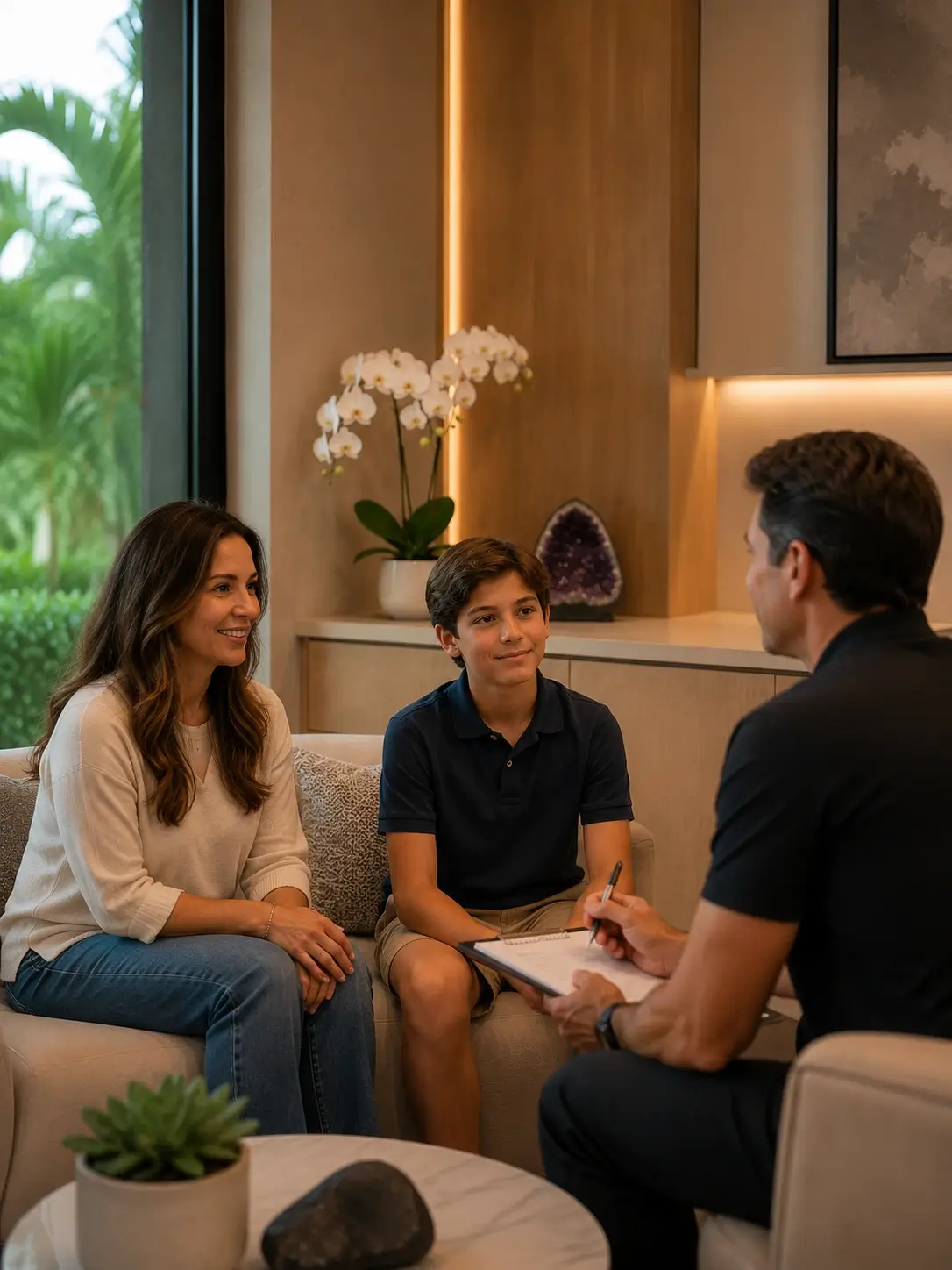
qEEG-Guided. Family-Oriented. Not a Generic Protocol.
Neurofeedback is widely available — but most providers use standardized protocols that don’t account for the individual’s actual brainwave map. Harper MD, in partnership with SYMMETRY Neuro-Pathway Training, delivers qEEG-guided neurofeedback: training built from your — or your child’s — specific brain map, not a generic template.
qEEG brain mapping first
Every protocol at Harper MD begins with a Brain Map — identifying exactly which frequencies are dysregulated and where. Training is built from that data, not assumed.
Appropriate for the whole family
Children as young as school age, adolescents, and adults can benefit. Many Weston families bring multiple members — a child for anxiety or focus, a parent for stress and cognitive performance — under one coordinated plan.
A Drug-Free Path for
Your Child or Yourself.
Your first evaluation at Harper MD is free, unhurried, and carries no commitment. We’ll review your goals — or your child’s — discuss whether neurofeedback is appropriate, and outline what a qEEG-guided training plan would look like.
17150 Royal Palm Blvd #3, Weston, FL · No commitment required
Neurofeedback — Frequently Asked Questions
Questions about neurofeedback at Harper MD in Weston, FL. For more, visit our FAQ page or contact us directly.
Yes. Neurofeedback is a well-established, drug-free, non-invasive approach that has been used with children since the 1970s. EEG sensors placed on the scalp only listen to brainwave activity — they do not emit electricity. The process is painless and most children describe it as relaxing, like watching a movie. NIH research on neurofeedback in pediatric populations documents its safety and outcomes across anxiety, ADHD, and related conditions. At Harper MD, care decisions are made following evaluation with full awareness of the child’s health context.
Not at all. EEG sensors placed on the scalp only monitor electrical activity — they don’t emit any signal or electricity whatsoever. Sessions involve watching a movie or simple visual display while the brain trains passively. Most patients — including children — describe the experience as relaxing. There is no discomfort, no recovery period, and no restrictions afterward.
The number of sessions depends on what the qEEG Brain Map identifies and how the individual responds to training. Some patients notice meaningful changes within several sessions; others benefit from a longer course. Sessions are typically conducted 2–3 times per week for optimal neural learning. Specific recommendations are made following evaluation and adjusted based on ongoing progress tracking.
Because neurofeedback works through neuroplasticity — actually retraining how the brain regulates itself — improvements tend to be durable. Unlike medication, which manages symptoms while being taken, neurofeedback trains the brain to produce healthier patterns on its own. Results that develop through training generally hold, though some individuals benefit from periodic maintenance. NIH research on neuroplasticity and lasting behavioral change supports the durability of training-based brain regulation improvements.
Medication manages symptoms while it’s being taken — it doesn’t change the underlying brain regulation patterns causing them. Neurofeedback trains the brain to self-regulate differently, so improvements continue after the training ends. It is not a replacement for medication in every case, and Harper MD doesn’t make that claim. But for families seeking a drug-free option — or a complement to existing care — neurofeedback addresses the regulatory source rather than the symptomatic surface. NIH review of neurofeedback vs conventional approaches for attention and anxiety covers the comparative evidence.
Harper MD delivers neurofeedback in partnership with SYMMETRY Neuro-Pathway Training, using a qEEG-guided system. Training is based on a personalized Brain Map rather than a generic protocol — this is what differentiates qEEG-guided neurofeedback from basic biofeedback or standardized neurofeedback programs. Sessions are conducted at Harper MD in Weston, FL with ongoing progress tracking throughout the training program.
Yes. Harper MD is located at 17150 Royal Palm Blvd #3, Weston, FL 33326 and serves families throughout West Broward and greater South Florida — including Pembroke Pines, Plantation, Davie, Cooper City, Parkland, Coral Springs, and Miramar. qEEG-guided neurofeedback is not widely available in the region, and families frequently travel specifically for Harper MD’s program. Contact us or get directions.
A Drug-Free Path Forward
For Your Family.
Your first evaluation at Harper MD is free, unhurried, and carries no commitment. We’ll review your goals — or your child’s — discuss whether neurofeedback is appropriate, and outline what a qEEG-guided training plan would look like.
17150 Royal Palm Blvd #3, Weston, FL · (954) 338-1111 · harpermd.com