Cellular Regenerative Therapy.
Repair From the Inside Out.
Cellular regenerative therapy uses concentrated biological material — derived from Wharton’s jelly, amniotic tissue, and related perinatal sources — that is rich in growth factors, extracellular matrix components, and signaling proteins. When introduced into a target tissue, this material supports the body’s own repair processes at the cellular level — improving the biological environment where regeneration occurs.
Used at Harper MD in Weston, FL for joint restoration, hair regeneration, and longevity support. Evaluation-first — never a generic protocol.
The Biological Materials Behind Cellular Regenerative Therapy
Cellular regenerative therapy at Harper MD draws from perinatal tissue sources — primarily Wharton’s jelly and amniotic tissue — that are exceptionally rich in the growth factors, cytokines, extracellular matrix proteins, and signaling molecules the body uses to coordinate repair. These materials are collected from healthy, consented donors at the time of birth and processed under strict regulatory standards.
Unlike PRP, which concentrates growth factors from the patient’s own blood, cellular regenerative therapy introduces a broader and more concentrated range of biological signals — including structural scaffolding proteins and cytokines that are not present in PRP. The two are complementary, not redundant, and are sometimes used together depending on evaluation findings. For the more targeted molecular communication approach, see exosome therapy.
All biological material used at Harper MD comes from FDA-registered tissue banks that comply with FDA HCT/P regulations for Human Cells, Tissues, and Cellular and Tissue-Based Products. Donors undergo extensive screening per established safety standards.
Book My Free EvaluationWharton’s Jelly
The gelatinous connective tissue of the umbilical cord, Wharton’s jelly is one of the richest known sources of growth factors, hyaluronic acid, collagen, and mesenchymal stromal cell-derived signaling molecules. Its extracellular matrix composition makes it particularly valuable for joint and tissue repair applications. NIH research documents its regenerative signaling properties.
Amniotic Tissue & Fluid
Amniotic membrane and fluid contain a concentrated mix of growth factors including EGF, FGF, TGF-β, and PDGF — proteins that regulate cellular proliferation, inflammatory response, and tissue remodeling. They also contain hyaluronic acid and fibronectin, structural proteins critical to extracellular matrix integrity. Published research on amniotic membrane growth factor content supports its clinical application in tissue repair.
Growth Factors & Extracellular Matrix
The therapeutic value of these materials lies in their combined content: growth factors that trigger cellular repair, cytokines that modulate inflammation, hyaluronic acid that supports tissue lubrication and hydration, collagen that provides structural scaffolding, and fibronectin that guides cell migration. Together they recreate the biological environment the body uses to coordinate repair — at higher concentrations than the aging body can produce on its own.
Three Mechanisms That Drive Cellular Repair
When introduced into target tissue, the biological material in cellular regenerative therapy works through three coordinated mechanisms. The combined effect is a more favorable repair environment — one the aging or damaged body cannot reliably produce on its own. A foundational overview of how growth factors coordinate tissue repair is available from the National Library of Medicine’s tissue repair reference.
Growth Factor Delivery & Cellular Signaling
Growth factors including EGF (epidermal growth factor), PDGF (platelet-derived growth factor), TGF-β (transforming growth factor beta), and FGF (fibroblast growth factor) bind to receptors on local cells and activate repair-promoting gene expression. This upregulates cellular proliferation, migration, and differentiation — the core processes of tissue restoration. NIH research on growth factor mechanisms in tissue repair documents these pathways in detail.
Extracellular Matrix Restoration
The extracellular matrix (ECM) is the structural scaffolding cells require to migrate, adhere, and function at the repair site. Wharton’s jelly and amniotic tissue are rich in collagen, fibronectin, laminin, and hyaluronic acid — the exact ECM proteins depleted in aging and damaged tissue. Restoring this scaffolding enables more organized and durable tissue repair. The role of the ECM in regenerative medicine is reviewed in published NIH research on Wharton’s jelly composition.
Inflammatory Modulation
Chronic low-grade inflammation is one of the primary barriers to effective tissue repair. The cytokines and anti-inflammatory proteins present in amniotic and Wharton’s jelly-derived materials help shift the local cellular environment from pro-inflammatory to pro-regenerative — reducing the conditions that suppress healing and creating space for productive repair to occur. Research on perinatal tissue-derived anti-inflammatory signaling supports this mechanism.
Services That Use Cellular Regenerative Therapy
Cellular regenerative therapy is applied across three service areas at Harper MD — always as part of an evaluation-driven, coordinated protocol. The specific biological components and delivery method vary by application and individual patient profile.
Joint Restoration
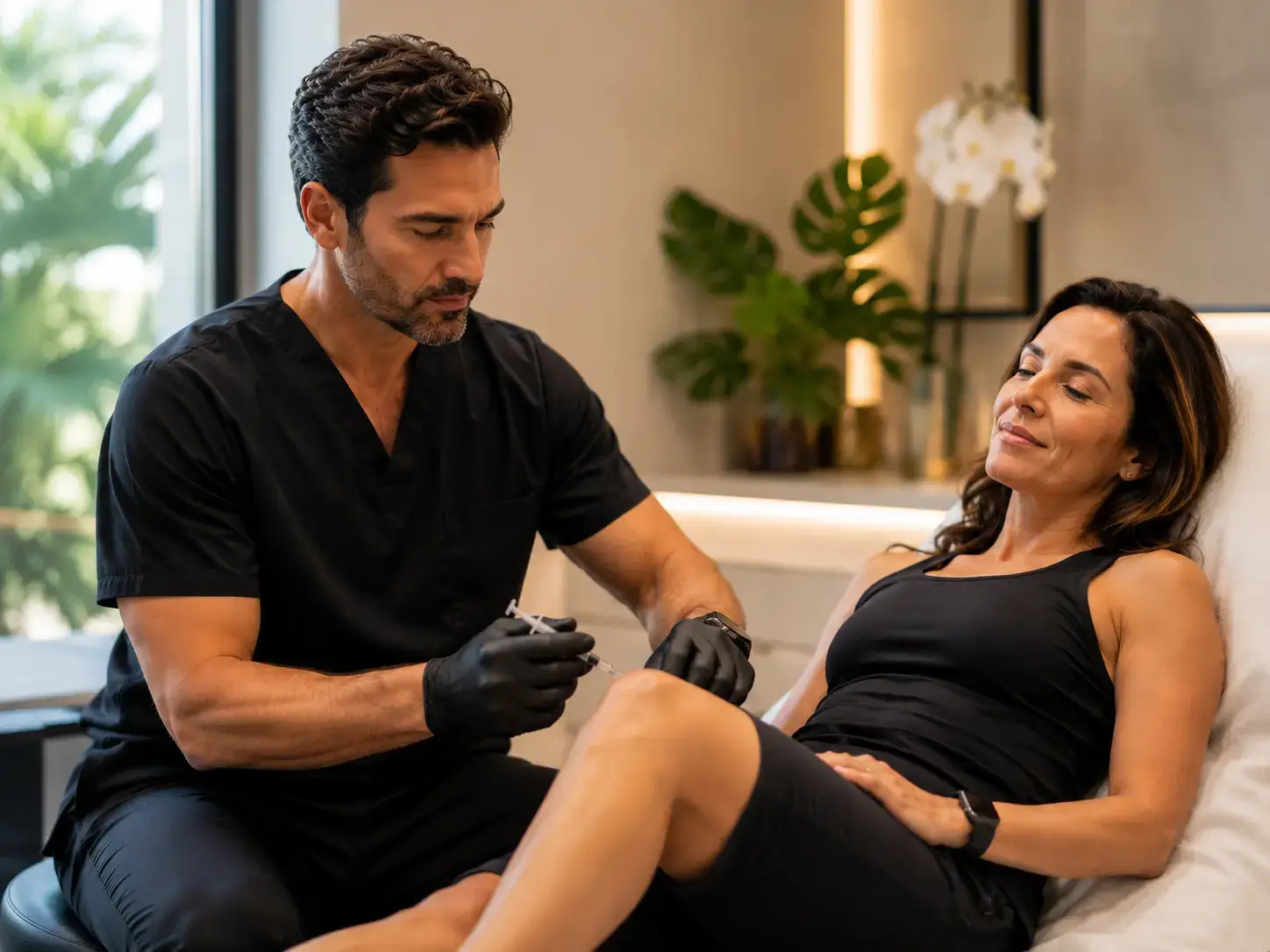
Cellular regenerative therapy is injected directly into the joint environment, delivering growth factors, ECM proteins, and anti-inflammatory cytokines to the site where repair is needed. It supports cartilage protection, reduces chronic inflammatory burden, and restores the biological conditions for more complete joint recovery — particularly in knees, shoulders, and hips.
Hair Regeneration
Applied to the scalp via microinjection, cellular regenerative therapy restores the cellular environment surrounding hair follicles — including microvascular support, inflammatory regulation, and the structural tissue quality follicles require to cycle predictably. Used alongside exosome therapy for enhanced follicular signaling support.
Anti-Aging & Longevity
Used as part of systemic longevity protocols to support cellular renewal, tissue quality, and the anti-inflammatory signaling that declines with biological aging. When used systemically, the growth factor and cytokine content supports the broader biological environment that governs resilience, recovery, and long-term physical capability.
What Makes Harper MD Different for Cellular Regenerative Therapy
Cellular regenerative therapy is increasingly offered across South Florida — often as a standalone injection without evaluation, without physician oversight, and without a coordinated protocol. Harper MD’s approach is the opposite. The therapy is one component of a plan built around your specific biology, goals, and the tissues that need support.
FDA-registered source tissue only
All biological material comes from accredited tissue banks that comply with FDA HCT/P regulations. Not all providers use regulated sources.
Never a standalone injection
Cellular regenerative therapy at Harper MD is always part of a coordinated protocol — combined with exosome therapy, peptide therapy, or other modalities as indicated by evaluation.
Compliance-first language
Harper MD does not market this care as “stem cell therapy.” That label creates regulatory and patient expectation problems. The therapy is described accurately — cellular regenerative therapy using growth factors and extracellular matrix material.
Find Out If Cellular Regenerative Therapy Is Right for You
Your first evaluation at Harper MD is free, private, and grounded in your specific biology. We determine which tissues need support, which modalities are appropriate, and how cellular regenerative therapy — if indicated — fits into your care plan.
17150 Royal Palm Blvd #3, Weston, FL · No commitment required
Cellular Regenerative Therapy — Frequently Asked Questions
Questions about cellular regenerative therapy at Harper MD in Weston, FL. For the full FAQ, visit our complete FAQ page.
No. Harper MD uses the term “cellular regenerative therapy” to accurately describe what the treatment involves. The FDA has not approved stem cells as a drug product, and Harper MD does not use or market this care as “stem cell therapy.” The materials used are derived from perinatal tissue — primarily Wharton’s jelly and amniotic tissue — which contain growth factors, extracellular matrix components, and signaling proteins, not isolated stem cells intended as a drug.
Wharton’s jelly is the gelatinous connective tissue that surrounds the blood vessels of the umbilical cord. It is one of the richest known sources of growth factors, hyaluronic acid, collagen, and mesenchymal stromal cell-derived signaling molecules. It is used in cellular regenerative therapy because its extracellular matrix composition closely mirrors the biological scaffolding the body uses to coordinate repair — and it is collected at birth from healthy, consented donors without harm to the mother or child. NIH research documents the regenerative properties of Wharton’s jelly in detail.
Harper MD uses materials from accredited, FDA-registered tissue banks that comply with FDA HCT/P regulations for Human Cells, Tissues, and Cellular and Tissue-Based Products. All donor tissue undergoes extensive screening and testing for infectious disease prior to use. Donors are healthy, consenting individuals. Not all providers who offer regenerative therapies use FDA-registered, accredited sources — this is one of the most important questions to ask any provider.
PRP (Platelet-Rich Plasma) concentrates growth factors from the patient’s own blood. It is autologous — meaning it comes from you. Cellular regenerative therapy introduces a broader and more concentrated range of biological signals from screened donor perinatal tissue — including extracellular matrix proteins, cytokines, and hyaluronic acid that are not present in PRP. PRP is limited by what the patient’s own blood can provide; cellular regenerative therapy introduces material from a biologically younger, richer source. The two can be used together or separately depending on evaluation findings at Harper MD.
Cellular regenerative therapy uses whole biological material — the full complex of growth factors, extracellular matrix, and signaling proteins found in Wharton’s jelly and amniotic tissue. Exosome therapy uses isolated extracellular vesicles — nanoscale particles that act as a more targeted molecular delivery mechan#ism. Think of cellular regenerative therapy as restoring the full biological environment, and exosome therapy as delivering precise molecular instructions to specific cells. The two are complementary and are sometimes used together at Harper MD for a coordinated signaling approach.
At Harper MD, cellular regenerative therapy is applied in three service areas: joint restoration and relief (knees, shoulders, hips, and spine), hair regeneration (follicle environment restoration for thinning and recession), and anti-aging and longevity (systemic cellular environment support). Whether it is appropriate for your specific situation is determined during your free evaluation — not assumed in advance.
This depends on the condition being addressed, the target tissue, and how your biology responds. Harper MD does not sell session packages in advance. Your care plan will specify a protocol based on your evaluation findings — with clear rationale for frequency and duration. For joint restoration, a single application followed by monitoring is common before determining next steps. For hair regeneration and longevity, protocols often involve a series spaced over several months.
Yes. Harper MD does not administer cellular regenerative therapy without a comprehensive evaluation. The evaluation determines whether this therapy is appropriate for your specific condition, which biological material is most suitable, and how it fits into your overall care plan. The first evaluation is free and requires no commitment. Book your free evaluation here.
Yes. Harper MD is located at 17150 Royal Palm Blvd #3, Weston, FL 33326 and serves patients throughout West Broward and greater South Florida — including Pembroke Pines, Plantation, Davie, Cooper City, Parkland, Coral Springs, and Miramar. Patients traveling from across South Florida for cellular regenerative therapy are welcome. Contact us or get directions.
Repair Starts With
the Right Environment.
Your first evaluation at Harper MD is free, unhurried, and grounded in your specific biology. Cellular regenerative therapy is one tool in a coordinated approach — the evaluation determines whether it applies to you, and exactly how.
17150 Royal Palm Blvd Ste 3, Weston, FL · (954) 338-1111 · harpermd.com