Leading the Way To Better Health For Every Member of Your Family.
Most approaches manage symptoms or slow decline. Harper MD rebuilds your body’s ability to repair, recover, and perform — starting at the cellular level.
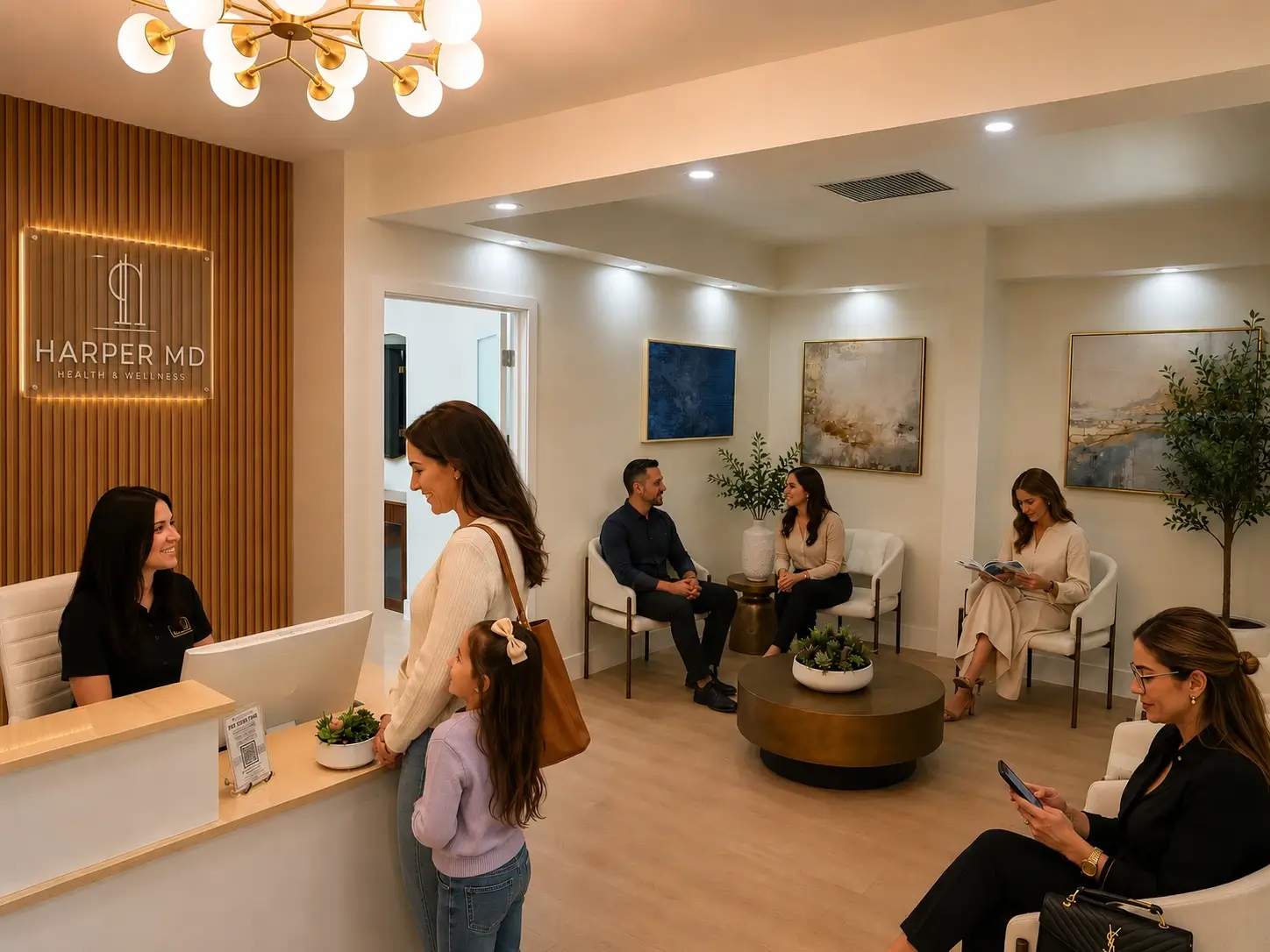
A Regenerative Health Clinic Built for Your Entire Family
Harper MD was founded because too many capable, active adults were being offered only two paths by the traditional health system: manage symptoms indefinitely, or wait until damage becomes severe enough to justify surgery.
We exist to serve the space in between — where proactive, regenerative intervention can restore function before irreversible decline sets in. Our approach is deliberate, evaluation-first, and built around understanding the whole picture — not just the presenting concern.
Harper MD is not a franchise. It is not a wellness spa. It is a medical clinic purpose-built for people who refuse to accept that limitation is the default outcome of an active life.
Why Families Choose a Different Approach
Most decline isn’t sudden — it shows up in small, familiar ways. You work out and feel sore for days instead of hours. A knee or shoulder never quite feels right. You sleep, rest, stretch — and still wake up worn down. These aren’t signs your body stopped working. They’re signs your recovery systems can’t keep up with demand.
Recovery Can’t Keep Up With Demand
Every movement places stress on tissue. In a healthy system, that stress is repaired quickly and completely. When recovery capacity drops, small issues stack up instead of clearing — what bounced back overnight now lingers for days.
Repair Starts — But Never Finishes
The body still attempts to recover, but the process becomes incomplete. Repair starts, stalls, and never fully restores tissue quality before the next demand arrives. Discomfort returns quickly. Performance plateaus. Recovery feels unpredictable.
Symptoms Get Managed Instead of the System
Most care focuses on reducing discomfort in the moment. That helps temporarily — but it doesn’t restore the systems responsible for repair. Without rebuilding recovery capacity, the same issues resurface the moment activity increases.
Regenerative Health Services for Every Stage of Life
Each service addresses a different expression of declining recovery capacity. Our care supports tissue health, system resilience, and long-term function — not managing symptoms indefinitely.

Joint Restoration & Relief
For the active adult whose recovery time has stretched, whose joint never fully healed, or who is trying to preserve function before damage compounds. Harper MD is the only clinic in the 15-mile radius offering shockwave therapy and the full cellular regenerative stack for musculoskeletal conditions.
Explore Joint Restoration
Metabolic & Weight Health
Medically supervised protocols designed to improve how your body functions — not just how it looks.
Explore →
Anti-Aging & Longevity
Systemic support for energy, cognitive sharpness, and long-term resilience for the professional or active retiree.
Explore →
Sexual Health & Wellness
Addressing function, intimacy, and hormone-related concerns with discretion and clinical precision.
Explore →
Hair Regeneration
PRP, exosome therapy, and cellular regenerative approaches for thinning and recession. For men and women 40–65.
Explore →
What Our Patients Are Saying
From the moment I walked in, the experience was unlike any clinic I’ve visited. The environment is warm, thoughtfully designed, and genuinely calming. The staff made me feel like a person — not a number on a chart.
The consultation was unlike anything I’ve experienced in a clinical setting. Unhurried, thorough, and genuinely personal. I walked out with an actual plan tailored to me — not a generic protocol or a referral to somewhere else.
My husband and I came in together for different concerns. The team managed both of us seamlessly — attentive, unhurried, and professional without being cold. The clinic itself feels like a place you actually want to come back to.
Start With a Free Evaluation.
No commitment — just clarity.
We review your history, your goals, and your options. You leave with a clear plan — not a prescription. No obligation whatsoever.
A Different Way Forward
More active adults are questioning the surgery-and-pharmaceutical-first approach to care. Harper MD is built around earlier, more deliberate intervention — designed to support function, resilience, and sustained performance over time.
| Conventional Care | Harper MD |
|---|---|
| Reacts to damage after it occurs | Intervenes proactively — before damage compounds |
| Manages symptoms in the short term | Rebuilds the body’s capacity to repair and recover |
| Surgery or medication presented first | Regenerative health therapies evaluated first |
| Wait until it’s severe enough to justify care | Support the system before decline becomes irreversible |
| Volume-based, rotating providers | Deliberate, unhurried, continuous relationship |

Regenerative Health for Every Member of Your Family
Harper MD is for active adults in their 40s, 50s, and 60s who value performance, independence, and long-term function. Professionals, parents, and active retirees who want to stay engaged in the activities that define their lives — without defaulting to surgery, pharmaceuticals, or the “just manage it” approach.
This isn’t designed for quick fixes or one-size-fits-all care. It’s built for people who are proactive, research-oriented, and invested in staying strong over time.
Read More About UsFrequently Asked Questions
Everything you need to know about Harper MD, regenerative health therapies, and what to expect when you come in.
Conventional medicine typically responds to symptoms after they appear — managing pain, prescribing medication, or waiting until a condition is severe enough to justify surgery. Regenerative health takes a different approach: it focuses on supporting the body’s own repair mechanisms at the cellular level, before damage becomes irreversible.
At Harper MD, we use therapies like peptide therapy, exosome therapy, PRP, and IV therapy to support recovery capacity, tissue quality, and long-term function — for patients of all ages. According to the National Institutes of Health, regenerative medicine is an evolving field that applies biological science principles to promote tissue repair and functional restoration.
Harper MD’s services are designed for adults, typically 18 and older. Our new family-focused positioning reflects the reality that health decisions in most households are made together — and that the whole family benefits when one member improves their health. We commonly see couples, parents and adult children, and multigenerational households coming in together.
Our services span joint restoration for the grandparent who wants to stay active, metabolic health for the parent managing their weight, and longevity care for anyone who wants to stay healthy and capable for the people they love.
Your first evaluation at Harper MD is completely free and carries no commitment. It is not a checklist or a sales appointment — it is a conversation. We take a thorough history, discuss your current health picture, your goals, and what’s been missing from the care you’ve received elsewhere.
From there, if there is a clear fit between your needs and what we offer, we present an individualized care plan. You decide whether to move forward, on your own timeline. To book your free evaluation, visit our Contact page or schedule online.
Most regenerative health therapies — including PRP, exosome therapy, peptide therapy, and IV therapy — are not covered by standard health insurance because they are administered outside of the conventional treatment model. Harper MD is a self-pay clinic, meaning care is billed directly and transparently without insurance dependency.
We accept HSA and FSA funds, and we offer payment plans through Cherry financing. Many of our patients find that investing in proactive regenerative care reduces long-term healthcare costs by delaying or avoiding more expensive interventions like surgery. Visit our Payment Plans page to learn more about financing options.
Harper MD is located at 17150 Royal Palm Blvd Ste 3, Weston, FL 33326. We primarily serve West Broward County, including Weston, Pembroke Pines, Plantation, Davie, Cooper City, Parkland, Coral Springs, and surrounding South Florida communities. We are bilingual — serving patients in both English and Spanish.
To get directions or reach our team, visit our Contact page or call us directly at (954) 338-1111.
Harper MD offers a comprehensive stack of regenerative health therapies, including cellular regenerative therapy, exosome therapy, peptide therapy, IV therapy, red light therapy, shockwave therapy, and hydrogen therapy.
These modalities are applied across our six core service areas: joint restoration, metabolic health, anti-aging & longevity, sexual health, hair regeneration, and neurofeedback. Learn more on our Therapies hub.
Absolutely. We see couples frequently — both together and individually — and we actively encourage it. Health decisions in a family context are better when both partners are informed and aligned. Many couples come in with different goals: one addressing joint recovery, another focused on energy, metabolic health, or sexual wellness. Each person receives their own individualized evaluation and care plan.
If both of you are ready to take a proactive approach to your health, book your free evaluations together and we will coordinate your visits.
Start With Understanding Your Body
This approach is designed for individuals who value precision, long-term outcomes, and proactive health decisions. Your first evaluation is free. No commitment required.
17150 Royal Palm Blvd Ste 3, Weston, FL · Serving West Broward & Greater South Florida