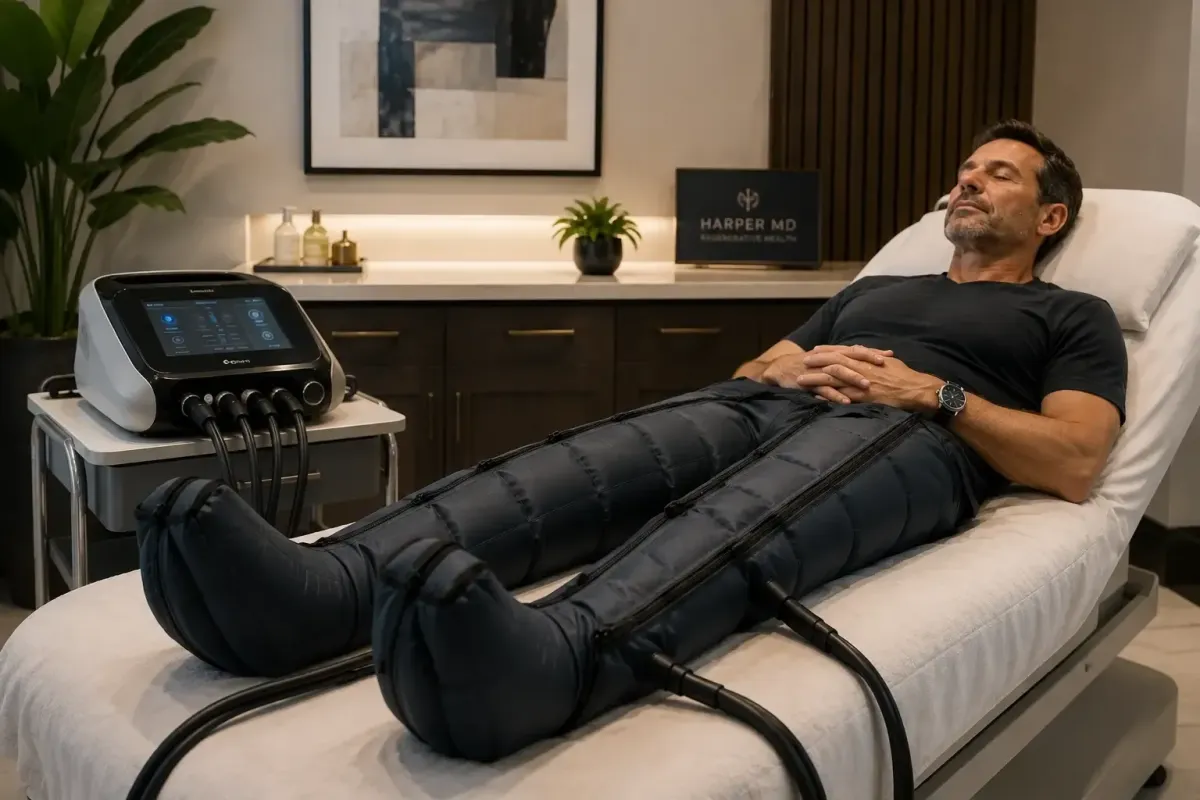
Pressotherapy for Athletic Recovery and Heavy, Tired Legs
Every active adult knows the feeling. The legs that are heavy the morning after a hard session. The calves that feel full and tight after a long run or a day on the pickleball court. The general sense that your lower body is carrying the weight of yesterday's effort into today, and that recovery is taking longer than it used to.
For the active adults Harper MD serves in Weston, recovery is not a luxury. It is the thing that determines whether you can train consistently, compete at the level you want, and stay active without accumulating the wear that eventually forces a slowdown. Pressotherapy is one of the more comfortable and accessible tools available for supporting that recovery, and this article explains how it works for the legs specifically.
This article is part of Harper MD's pressotherapy series. For a complete overview of how pressotherapy works, what the lymphatic system does, and what the evidence supports, read our full guide: What Is Pressotherapy? A Complete Guide for Active Adults in Weston at harpermd.com/post/what-is-pressotherapy.
Why Legs Feel Heavy After Exertion
The heaviness you feel in your legs after intense activity is not just muscle fatigue. It involves fluid dynamics.
When you train hard, several things happen in the lower body at once. Muscle tissue experiences microscopic damage, which is a normal and necessary part of the adaptation process. The body responds with an inflammatory cascade that brings fluid and repair resources to the area. Metabolic byproducts accumulate in the tissue. And because the legs are the furthest point from the heart, gravity works against the efficient return of fluid and blood back toward the center of the body.
The result is a temporary state where fluid and metabolic byproducts accumulate in the lower limbs faster than the body clears them. This is the heaviness, the tightness, and the swelling that active adults recognize after hard efforts. It is also part of why recovery slows with age, as the circulatory and lymphatic efficiency that cleared this accumulation quickly in your 30s becomes less efficient over time.
Pressotherapy addresses this directly by mechanically assisting the movement of accumulated fluid out of the legs and back toward the central circulatory and lymphatic systems.
How Pressotherapy Supports Recovery
Pressotherapy uses a multi-chamber garment, in this case typically boots that cover the legs, connected to a compression device that inflates and deflates the chambers in sequence. The compression begins at the feet and moves upward toward the hips, creating a wave of pressure that pushes fluid in the direction the body needs it to go.
For recovery specifically, this sequential compression supports several processes:
Fluid clearance. The wave-like compression encourages the movement of accumulated fluid and metabolic byproducts out of the tissue and back toward central circulation, where they can be processed and removed.
Circulation support. By moving blood toward the heart, the compression supports the delivery of fresh, oxygenated blood back into the muscle tissue, which is what the repair process depends on.
Reduced sensation of heaviness. As fluid moves out of the legs, the subjective feeling of heaviness and fullness diminishes, which is why so many people describe a sensation of lightness in the legs after a session.
The evidence for this application is developing but promising. A systematic review and meta-analysis examining pressotherapy for performance and recovery in the management of delayed onset muscle soreness found that pressotherapy and related compression techniques were used across studies to support recovery following exercise. See: The Effect of Pressotherapy on Performance and Recovery in Delayed Onset Muscle Soreness.
Who This Is For
Pressotherapy for recovery and heavy legs is particularly relevant for several groups of active adults:
•Athletes and weekend warriors who train hard and want to support recovery between sessions, whether that is tennis, pickleball, golf, cycling, running, or strength training
•Active adults over 45 whose recovery has slowed and who want to support the circulatory and lymphatic efficiency that clears post-exercise fluid accumulation
•People who spend long days on their feet and finish the day with heavy, tired legs
•Frequent travelers who experience leg heaviness and swelling after long flights or extended sitting
•Anyone who experiences the sensation of restless, heavy, or full legs and wants a comfortable, non-invasive option for relief
Pressotherapy is not appropriate for everyone. People with a history of blood clots, deep vein thrombosis, severe cardiovascular disease, active infection, or who are pregnant should not undergo pressotherapy without medical clearance. This is why Harper MD screens every candidate before beginning.

How to Use Pressotherapy in a Recovery Routine
Pressotherapy is most effective as part of a consistent recovery approach rather than a one-time treatment. Because the benefits support ongoing recovery rather than producing a single permanent change, many active adults incorporate it on a regular cadence, particularly around periods of intense training or competition.
A typical session runs 30 to 45 minutes, requires nothing of you beyond relaxing in the garment, and has no downtime afterward. Many people find it a genuinely pleasant part of their routine, using the time to rest, read, or simply decompress while the compression does its work.
Pressotherapy also works well alongside Harper MD's other recovery-focused services. For active adults managing joint and tissue recovery, it complements shockwave therapy and joint restoration, and for those focused on comprehensive recovery, it pairs naturally with
If heavy, tired legs or slow recovery have been limiting you, an evaluation is the place to start. Book at harpermd.mybodysite.com/harper-md-booking-page.
Frequently Asked Questions
How soon after exercise should I do pressotherapy? There is flexibility here. Some active adults use pressotherapy on the same day as intense activity to support recovery, while others use it on rest days or on a regular weekly cadence. The right timing depends on your training schedule and goals, which your provider can help you plan during your evaluation.
Will pressotherapy help my legs look less swollen? It may temporarily reduce the sensation and appearance of fluid-related swelling in the legs, because it moves accumulated fluid out of the tissue. This effect is related to fluid movement, not fat loss, and it is generally temporary. Many people appreciate the feeling of lightness it provides.
Can I do pressotherapy if I train frequently? For appropriate candidates, pressotherapy can be used regularly as part of an ongoing recovery routine. Because it is non-invasive and has no downtime, it fits well into a consistent training schedule. Harper MD will confirm it is appropriate for you and help set a sensible cadence.
Is this the same as the compression boots athletes use? The underlying technology, sequential pneumatic compression, is the same category. Pressotherapy at Harper MD is delivered with medical-grade equipment as part of an evaluated, individualized approach rather than as an unmonitored consumer product, and it begins with screening to confirm it is appropriate for you.
