![Active adult in their early 50s engaged in resistance training, representing the body composition and performance goals that peptide therapy at Harper MD is designed to support]](https://images.leadconnectorhq.com/image/f_webp/q_80/r_1200/u_https://assets.cdn.filesafe.space/BjdJQzXsoMWLKLk4nhQL/media/6a09d69f2e98e28fa1628cbf.webp)
Peptide Therapy for Body Composition After 45 — Addressing the Fat and Muscle Shift That Training Alone Can't Fix
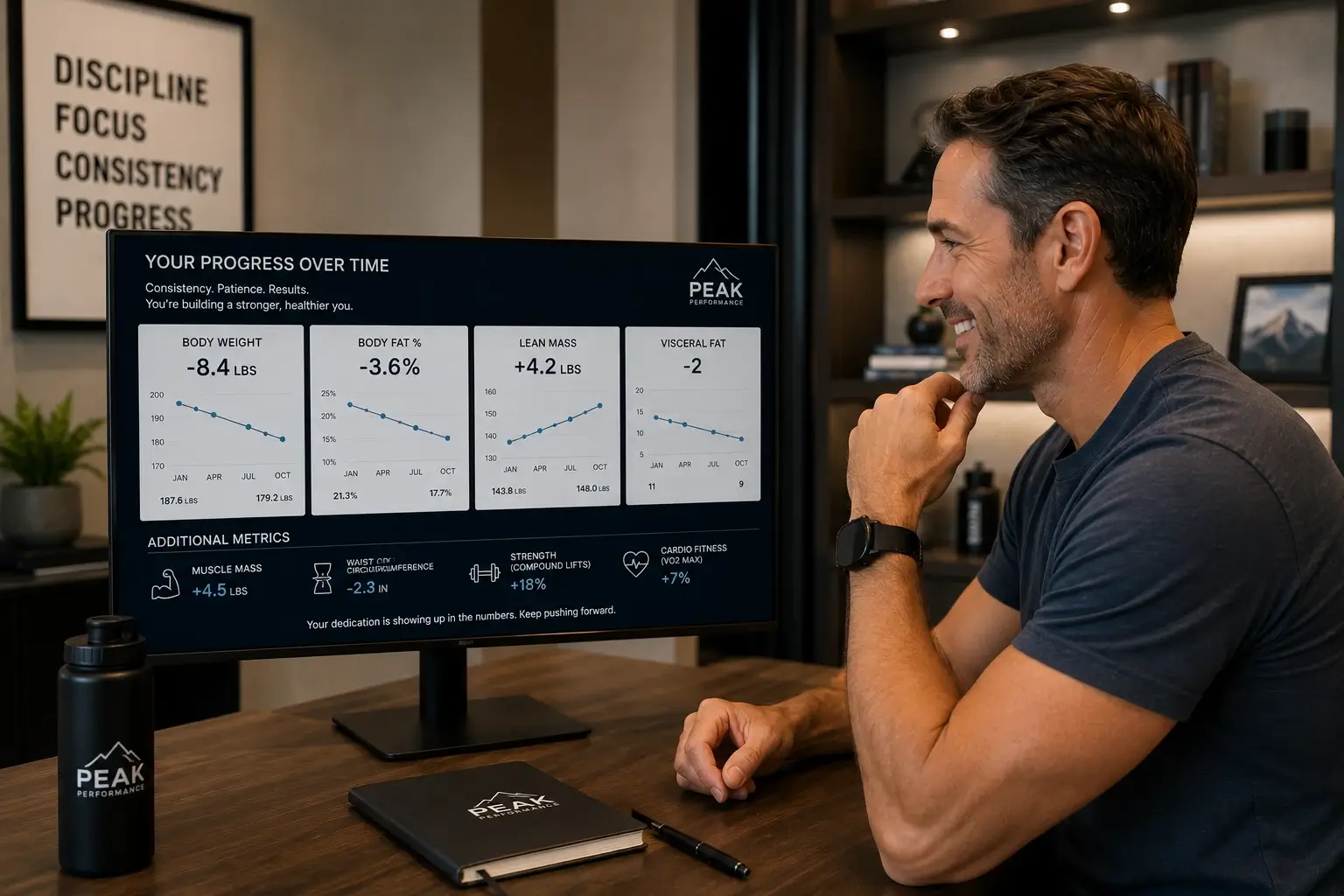
You haven't changed what you eat. You haven't stopped training. In some cases, you're working harder than you were a decade ago. And yet the body is different — the midsection carries weight it didn't used to carry, the muscle that responded predictably to effort now requires more stimulus for less return, and the definition that came without much thought in your 30s now feels like a moving target.
This is one of the most common and most frustrating experiences for active adults in their 40s and 50s. And it is also one of the most misunderstood — because the advice most people receive treats it as a discipline problem when it is, in large part, a biology problem.
The body composition shift that happens after 45 is driven by specific hormonal and cellular changes — declining growth hormone, shifting testosterone and estrogen levels, reduced insulin sensitivity, and a gradual erosion of the biological infrastructure that kept body composition stable for decades. Addressing it effectively means addressing those mechanisms directly, not just increasing effort against a system that is no longer responding to effort the way it once did.
Peptide therapy — specifically the growth hormone-releasing peptides and Tesamorelin — targets these mechanisms at the cellular level. This blog explains how and for whom. For a complete overview of peptide therapy at Harper MD, see https://harpermd.com/post/what-is-peptide-therapy
Why Body Composition Changes After 45 — The Biology
Understanding what is actually driving the shift helps clarify why targeted interventions are more effective than generic intensification of effort.
Growth hormone decline. GH production declines at approximately 14 to 15 percent per decade after age 30. By the early 50s, most adults have GH levels that are a fraction of their peak. GH directly suppresses the activity of lipoprotein lipase — the enzyme that promotes fat storage, particularly visceral fat. As GH declines, that suppression weakens. Visceral fat accumulates. This is not a dietary failure. It is a hormonal shift with a specific, addressable mechanism.
Declining IGF-1. IGF-1 — the primary downstream mediator of growth hormone — drives muscle protein synthesis and satellite cell activation. As GH declines, so does IGF-1. The muscle that was once reliably responsive to training stimulus now has a weaker anabolic signal driving its repair and growth. The training effort goes in. The return diminishes.
Testosterone and estrogen changes. Testosterone in men and estrogen in women both influence body composition through distinct but complementary mechanisms. Testosterone supports lean mass and suppresses fat accumulation. Estrogen regulates fat distribution and protects against the visceral pattern. As both decline with age, the body composition environment becomes less favorable — and the effects compound with declining GH.
Insulin sensitivity reduction. Reduced GH, lower testosterone, and the metabolic effects of aging combine to reduce insulin sensitivity — the body's ability to use glucose efficiently. Reduced insulin sensitivity favors fat storage and makes it harder to use dietary carbohydrates effectively during and after training. The same meal that supported lean composition at 35 now has different metabolic consequences at 52.
These are not separate problems. They are interconnected changes to the same biological system — and they respond to interventions that address the system rather than just the caloric balance.
![Active adult in their early 50s engaged in resistance training, representing the body composition and performance goals that peptide therapy at Harper MD is designed to support]](https://assets.cdn.filesafe.space/BjdJQzXsoMWLKLk4nhQL/media/6a09d69f2e98e28fa1628cbf.webp "Active adult in their early 50s engaged in resistance training, representing the body composition and performance goals that peptide therapy at Harper MD is designed to support]")
Where Peptide Therapy Fits
Peptide therapy for body composition works by restoring the hormonal signaling that governs how the body manages fat and muscle — not by suppressing appetite or forcing a caloric deficit. The distinction matters because it determines both what peptide therapy can realistically accomplish and how it works alongside the active adult's existing training and nutrition habits.
GH-releasing peptides (Sermorelin, CJC-1295 / Ipamorelin). By stimulating the pituitary to produce more growth hormone in natural, pulsatile rhythms, these peptides restore the GH-IGF-1 axis toward a more favorable level. The downstream effects on body composition are well-documented: improved muscle protein synthesis, enhanced fat mobilization (particularly from visceral stores), better sleep quality (which itself supports body composition through its effects on cortisol and appetite hormones), and improved recovery from training — which allows the consistent training intensity that body composition maintenance requires.
Tesamorelin. Tesamorelin is a growth hormone-releasing hormone analog with FDA approval for the reduction of visceral adiposity — making it the most specifically targeted peptide available for the body composition concern that active adults in their 50s most commonly describe: the midsection shift that doesn't respond to diet and training. Its mechanism is direct: it stimulates pulsatile GH release with a particular affinity for the visceral fat reduction pathway. Clinical trials have demonstrated meaningful reductions in visceral adipose tissue that are not replicated by diet or exercise alone in the same population.
For many Harper MD patients, the most effective protocol combines GH-releasing peptides for the broader recovery and lean mass benefits with Tesamorelin specifically targeting the visceral fat component. The combination is determined by the patient's evaluation — their lab picture, their specific composition concerns, and the overall hormonal context.
The Role of Testosterone Alongside Peptides
For men whose body composition shift coincides with declining testosterone — which is the majority of active men in their late 40s and 50s — addressing body composition through peptide therapy alone produces incomplete results. Testosterone and growth hormone work synergistically: testosterone amplifies the anabolic signal from GH-driven IGF-1 elevation, and GH supports the connective tissue and recovery environment that testosterone-driven training demands.
The patients who see the most complete and durable body composition changes at Harper MD are typically those who address both — testosterone optimization alongside GH-releasing peptides — rather than treating each in isolation. For a detailed explanation of how low testosterone drives the body composition shift in active men, see our blog at harpermd.com/blog/low-testosterone-body-composition.
For women, the relationship between declining estrogen and body composition is equally significant — and estrogen optimization alongside GH peptide support addresses the dual drivers of the composition shift that active women in perimenopause and post-menopause experience.
What Realistic Results Look Like
Peptide therapy for body composition is not a shortcut. It restores the hormonal environment that makes training and nutrition work the way they should — it doesn't substitute for them.
For active adults who are already training consistently and eating reasonably, restoring GH levels and addressing visceral fat accumulation through Tesamorelin typically produces:
•Gradual reduction in visceral fat — most noticeable in the midsection — over three to six months of consistent protocol
•Improved lean muscle maintenance and training response — the muscle that used to respond to effort begins responding again
•Better sleep quality — the deep, slow-wave GH release during sleep improves, which compounds every other aspect of recovery and composition
•Improved energy and training consistency — the motivational substrate and physical recovery that supports sustained effort
•Improved connective tissue quality — tendons, ligaments, and cartilage benefit from GH-driven collagen support
The timeline is longer than most people want and shorter than most people fear. Meaningful body composition changes typically become visible at three to six months. The shift in how training feels — recovery, energy, muscle response — often begins within four to eight weeks.
Who Is a Strong Candidate
•Active adults 45–65 experiencing visceral fat accumulation and reduced lean mass despite consistent training and reasonable nutrition
•Men and women whose body composition shift has coincided with the hormonal changes of midlife — declining testosterone, estrogen, or measurably reduced IGF-1
•Patients already engaged in hormone optimization (TRT or HRT) who want to extend the benefit to include GH-related body composition support
•Active adults whose training and nutrition foundation is already in place — peptide therapy is most effective when it's restoring a system that is being properly loaded, not compensating for a foundation that isn't there
•Individuals who have tried increased training volume and caloric restriction without meaningful composition improvement — and want to understand whether the hormonal environment is the limiting variable
How to Get Started
A body composition evaluation at Harper MD begins with comprehensive lab work — IGF-1, full hormonal panel, metabolic markers, and body composition assessment. The protocol is built around what that picture shows, not a standard stack applied to everyone.
Learn more about Harper MD's complete peptide therapy program at harpermd.com/therapies/peptide-therapy, or book an evaluation at https://harpermd.mybodysite.com/harper-md-booking-page.
Frequently Asked Questions
Is Tesamorelin the same as semaglutide or other GLP-1 medications? No. They work through entirely different mechanisms. GLP-1 medications (semaglutide, tirzepatide) reduce weight primarily through appetite suppression and slowed gastric emptying. Tesamorelin works by stimulating growth hormone release, which directly targets visceral adipose tissue through the GH-IGF-1 axis. They address different aspects of body composition and can be complementary in the right clinical context.
Will I lose muscle mass on this protocol? The opposite is the goal — and the mechanism. GH-releasing peptides improve the anabolic environment for muscle maintenance. Unlike caloric restriction approaches that produce weight loss at the cost of lean mass, peptide-driven GH support specifically targets fat mobilization while preserving and supporting muscle tissue.
How long do I need to be on the protocol? Initial protocols typically run eight to twelve weeks, with lab reassessment to evaluate IGF-1 response and clinical progress. Many patients continue on a maintenance protocol after the initial course. The duration depends on your goals, your response, and the broader hormonal picture — your provider will give you a clear recommendation based on your evaluation.
Can I use these peptides without also doing TRT or HRT? Yes. GH-releasing peptides produce meaningful benefits independently of testosterone or estrogen optimization. However, for patients whose testosterone or estrogen levels are also suboptimal, addressing both produces more complete and durable results. The evaluation will clarify what your picture looks like and what the most appropriate sequence is.
Harper MD | 17150 Royal Palm Blvd #3, Weston, FL 33326 | (954) 338-1111 | harpermd.com
This content is for educational purposes only and does not constitute medical advice. Individual results vary. Not all peptides discussed are FDA-approved for all uses described. Consult a qualified healthcare provider to determine whether peptide therapy is appropriate for your specific situation.
