What Is Peptide Therapy? A Complete Guide for Active Adults
Peptides have become one of the most searched topics in regenerative health — and also one of the most poorly explained. Between the online hype, the gray-market sourcing concerns, and the clinics offering peptide protocols with minimal evaluation, it can be genuinely difficult to get a clear, honest picture of what peptide therapy is, what it can realistically do, and how to pursue it responsibly.
This guide is written for active adults who want that clarity. Not a sales pitch. Not a list of benefits without context. A straightforward explanation of what peptides are, how they work, which categories are most relevant for the Harper MD patient, and what a medically supervised approach actually looks like.
If you're in your 40s, 50s, or 60s and you're noticing that your body isn't recovering the way it used to — that your energy, body composition, sleep, or physical performance have shifted in ways that effort alone isn't fixing — peptide therapy may be one of the most targeted tools available for addressing what's happening at the cellular level.
What Peptides Are — And Why They Matter
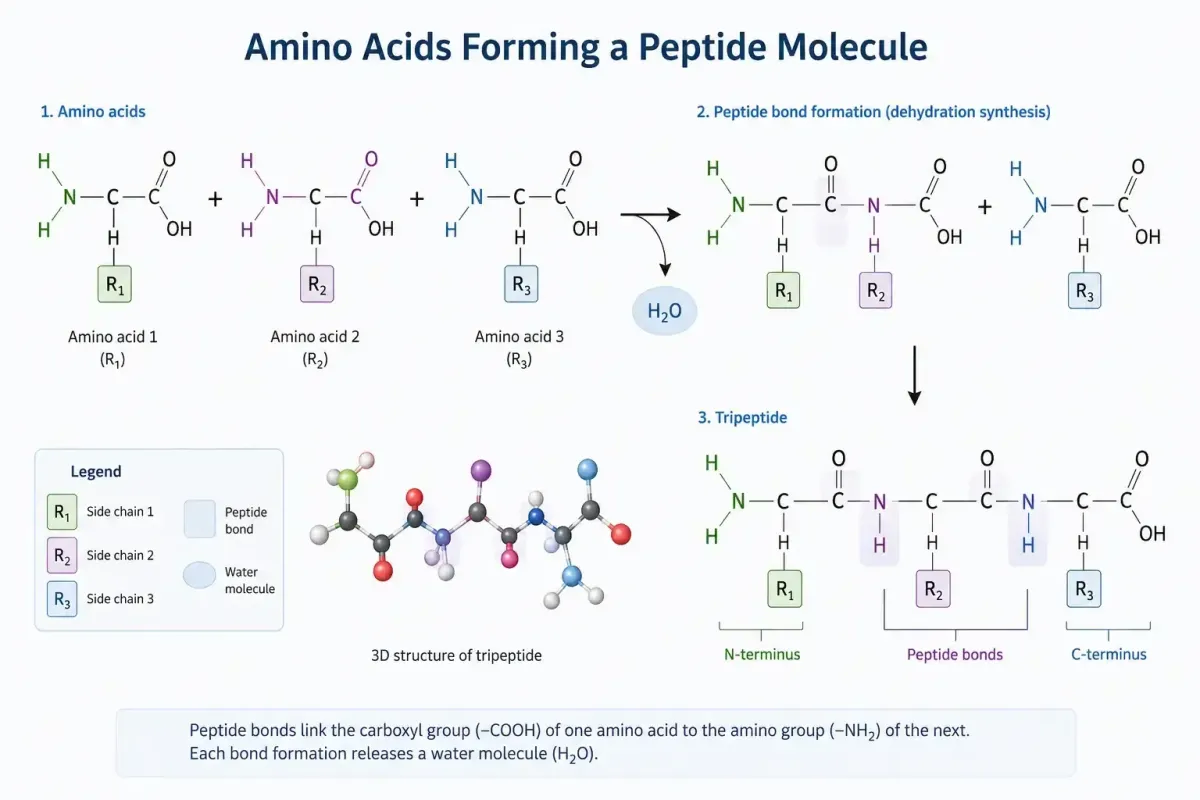
Peptides are short chains of amino acids — the same building blocks that make up proteins, but assembled in smaller, more specific sequences. The body produces thousands of peptides naturally, and they function as signaling molecules: precise chemical messengers that tell cells, tissues, and organs how to behave.
When a peptide binds to a receptor on a cell surface, it triggers a specific biological response. Depending on the peptide and the receptor, that response might be to release growth hormone, accelerate tissue repair, regulate inflammation, support immune function, or influence metabolic activity. Peptides don't introduce foreign chemistry into the body — they work with the body's existing signaling infrastructure.
The clinical relevance for active adults is this: as we age, the body's natural production of key peptides declines. Growth hormone-releasing peptides diminish, leading to reduced cellular repair capacity and changes in body composition. Tissue-repair peptides become less abundant, slowing recovery from training and injury. The signaling environment that kept the body performing reliably begins to degrade — not because the body has forgotten how to repair itself, but because the signals that drive repair have weakened.
Peptide therapy restores or supplements those signals — targeting specific biological pathways with precision that broader interventions like diet, exercise, or even hormone therapy can't replicate alone.
The Peptide Categories Most Relevant for Active Adults
Not all peptides work the same way or serve the same purpose. Understanding the main categories helps clarify which are most relevant for the concerns active adults in their 40s, 50s, and 60s typically bring to Harper MD.
Growth Hormone-Releasing Peptides
This is the most widely used category in regenerative health for active adults. Growth hormone — which declines significantly after the age of 30 — plays a central role in tissue repair, body composition, sleep architecture, and metabolic function. Rather than administering growth hormone directly, GH-releasing peptides stimulate the pituitary gland to produce and release more of its own growth hormone in natural, pulsatile rhythms.
The most commonly used in this category are Sermorelin, Ipamorelin, and CJC-1295. Each works through slightly different mechanisms and with different pharmacokinetic profiles. They are frequently used in combination to produce a more complete effect — Sermorelin or CJC-1295 as the growth hormone-releasing hormone analog, paired with Ipamorelin as a ghrelin-mimetic that amplifies the GH pulse.
The clinical applications for active adults include: improved body composition — particularly reduction of visceral fat and preservation of lean muscle — better sleep quality, faster recovery from training and physical demand, and improved connective tissue integrity. These are among the most searched peptides in South Florida and nationally, reflecting how broadly relevant these concerns are to the active adult demographic.
Tissue Repair and Recovery Peptides
BPC-157 is the most widely discussed peptide in this category and currently the most searched individual peptide globally. Derived from a protein found naturally in gastric juice, BPC-157 has demonstrated tissue repair properties in a significant body of preclinical research — accelerating healing in tendons, ligaments, muscle, and gut tissue, and modulating the inflammatory environment around damaged structures.
TB-500 (Thymosin Beta-4 fragment) works systemically — promoting cellular repair, reducing inflammation, and improving vascular supply to damaged tissue. It is frequently used alongside BPC-157 for active adults dealing with joint, tendon, or soft tissue conditions that haven't fully resolved with conventional care.
For the Harper MD patient managing a chronic tendon issue, a joint that hasn't fully recovered, or a recovery timeline that has stretched beyond what training adjustments alone can fix, this category is particularly relevant — and works naturally alongside shockwave therapy and cellular regenerative therapy as part of a broader joint restoration plan.
Metabolic and Body Composition Peptides
Tesamorelin is an FDA-approved growth hormone-releasing hormone analog with a strong evidence base for reducing visceral fat accumulation — the metabolically active fat around abdominal organs that becomes increasingly difficult to shift after 45. Its mechanism is specific: it stimulates pulsatile GH release that directly targets visceral adipose tissue, producing body composition changes that caloric restriction and exercise alone often can't replicate after significant hormonal decline.
For active adults dealing with a midsection that has shifted despite consistent training and reasonable nutrition, Tesamorelin — often used alongside other GH-releasing peptides or as part of a broader hormonal optimization plan — addresses the biological environment that is driving the change.
Sexual Health Peptides
PT-141 (Bremelanotide) is the only peptide in this class and one of the few with FDA approval — specifically for hypoactive sexual desire disorder in premenopausal women, though it is also used for sexual dysfunction in men. Unlike conventional sexual health medications that work through vascular mechanisms, PT-141 acts centrally — activating receptors in the hypothalamus that regulate sexual desire and arousal directly through the nervous system.
For active adults dealing with reduced libido, sexual function concerns, or intimacy changes that are affecting their relationship quality, PT-141 offers a mechanism that addresses the neurological component rather than just the physical — which is particularly relevant for patients whose concerns don't respond fully to hormonal optimization alone.

Why Medical Supervision Matters More Than It Used To
The peptide landscape in 2026 is more complicated than it was five years ago — and understanding why matters for anyone considering this path.
Peptide therapy has moved from niche wellness circles into mainstream demand rapidly, and the market has responded in ways that range from excellent to genuinely risky. Compounding pharmacies, online research chemical vendors, and direct-to-consumer peptide sellers now exist alongside medically supervised clinics — and the differences in sourcing, purity, dosing, and oversight are significant.
The FDA has increased scrutiny of compounded peptide products and the marketing claims surrounding them, particularly for peptides like BPC-157 that are widely used but not yet approved for human use. This regulatory attention is not a reason to avoid peptide therapy — it is a reason to pursue it through a clinic that sources from compliant, licensed compounding pharmacies, conducts proper evaluation before prescribing, and monitors outcomes rather than setting and forgetting.
The risks of unsupervised peptide use — whether from unverified online sources or from clinics that prescribe without adequate evaluation — include contaminated or mislabeled product, inappropriate dosing, and the compounding of risk factors that a proper evaluation would have identified. The active adult who has done their research and is approaching peptide therapy thoughtfully deserves a clinical partner who matches that standard.
Harper MD's approach: Every peptide protocol at Harper MD begins with a comprehensive evaluation — labs, health history, symptoms, and goals — before any protocol is designed. Peptides are sourced exclusively from licensed compounding pharmacies. Protocols are monitored and adjusted based on how the patient is responding, not applied uniformly and left unreviewed.
What the Evaluation Process Looks Like
Peptide therapy at Harper MD is not a menu you order from. It begins with understanding what's actually happening in your body and what your goals are — and then building a protocol around that picture.
A typical evaluation includes:
•Comprehensive lab work — including IGF-1 (the primary marker of GH activity), hormonal panels, metabolic markers, and inflammatory indicators relevant to your specific concerns
•A thorough review of symptoms — recovery patterns, sleep quality, body composition changes, energy, cognitive function, and any joint or tissue issues
•Health history — including any conditions, medications, or previous treatments that affect peptide candidacy
•Goal alignment — understanding what you're trying to address and building a protocol that is specifically calibrated to that, not a standard stack applied uniformly
From there, the protocol is designed — which peptides, which delivery method, what dosing frequency, and what monitoring cadence. Most peptides are delivered via subcutaneous injection, which most patients self-administer at home after an in-office demonstration. Some peptides are available in nasal spray or oral forms depending on the specific application.
Monitoring is ongoing. Lab markers, symptom tracking, and protocol adjustments are built into the program — because the goal is optimization that holds over time, not a short course that produces temporary change.
Who Is the Right Candidate for Peptide Therapy
Peptide therapy at Harper MD is most appropriate for active adults whose biological performance has shifted in ways that conventional care hasn't addressed — and who are looking for targeted, evidence-informed tools to support recovery, body composition, hormonal function, or longevity.
Strong candidates typically include:
•Active adults 40–65 experiencing slower recovery from training, sport, or daily physical demand
•Men and women dealing with body composition changes — particularly visceral fat accumulation and muscle loss — despite consistent training and reasonable nutrition
•Patients already engaged in hormone optimization who want to extend the benefit to include GH-related recovery and tissue repair
•Active adults managing chronic joint, tendon, or soft tissue issues who want to address the tissue repair environment alongside — or between — other regenerative therapies
•Individuals experiencing sleep quality decline, flat energy, or reduced cognitive sharpness that has a hormonal or cellular component
•Adults dealing with sexual health changes that haven't responded fully to hormonal optimization
Peptide therapy is not appropriate for everyone — and Harper MD doesn't present it as a universal solution. Certain health conditions, medications, and individual factors affect candidacy. The evaluation process exists to determine what is appropriate for your specific situation — not to sell you a protocol.

How Peptide Therapy Fits Into Harper MD's Regenerative Health Approach
Peptide therapy rarely produces its best results in isolation. At Harper MD, it is most effective as part of a broader regenerative health plan that addresses the patient's full picture — hormonal, cellular, and tissue-specific.
The connections are direct and clinically meaningful:
•GH-releasing peptides work synergistically with testosterone and estrogen optimization — the hormonal environment determines how effectively peptide-driven GH translates into tissue repair and body composition benefit
•BPC-157 and recovery peptides complement shockwave therapy and cellular regenerative therapy for joint and tendon conditions — addressing the systemic tissue repair environment alongside the targeted local treatment
•Metabolic peptides like Tesamorelin work alongside medical weight management programs to address the hormonal drivers of body composition change, not just the caloric ones
•PT-141 works alongside hormonal optimization and sexual health services to address the full picture of sexual function — neurological and physiological simultaneously
•IV therapy provides the micronutrient and antioxidant substrate that tissue repair and cellular signaling depend on — supporting the environment in which peptide protocols operate
The patients who see the most durable, comprehensive results from peptide therapy at Harper MD are those who approach it as one component of a deliberate, evaluated plan — not a standalone shortcut. That's the standard we hold for every protocol we build.
If you're ready to understand what your biological picture actually looks like and whether peptide therapy is appropriate for your situation, the starting point is an evaluation. Book at https://harpermd.mybodysite.com/harper-md-booking-page or contact us at harpermd.com/contact-us.
Frequently Asked Questions
Are peptides safe? The safety profile varies significantly by peptide. Some, like PT-141 and Tesamorelin, are FDA-approved with well-characterized safety data from clinical trials. Others, like BPC-157, have extensive preclinical research but limited large-scale human trial data. Medical supervision, compliant sourcing, and appropriate monitoring are what make a peptide protocol genuinely safe — not the peptide name alone. Harper MD uses only licensed compounding pharmacy sources and monitors every protocol.
Do I need a prescription for peptide therapy? Some peptides — including PT-141 and Tesamorelin — require a prescription and are only legally available through licensed medical providers. Others exist in a more complex regulatory space. Harper MD operates strictly within legal and compliant pathways. All protocols are physician-supervised and sourced through licensed facilities.
How long before I notice results? It depends on the peptide and what you're addressing. Tissue repair peptides like BPC-157 may produce noticeable changes within two to four weeks for acute applications. GH-releasing peptides typically require four to eight weeks for measurable changes in sleep, recovery, and energy — and eight to twelve weeks or more for meaningful body composition shifts. Your provider will set realistic expectations based on your specific protocol and starting point.
Can peptide therapy be combined with TRT or HRT? Yes — and for many patients, the combination produces more comprehensive results than either approach alone. GH-releasing peptides work synergistically with testosterone and estrogen in ways that amplify the benefit of both. The evaluation process determines the right combination and sequencing for your individual picture.
How is Harper MD's approach different from online peptide sources or direct-to-consumer clinics? Harper MD evaluates before prescribing — labs, symptoms, health history, and goals — and monitors throughout. Peptides are sourced from licensed compounding pharmacies. Protocols are adjusted based on how you're responding, not sold as a fixed package. The difference is clinical rigor and ongoing accountability — not just access to the peptides themselves.
Harper MD | 17150 Royal Palm Blvd #3, Weston, FL 33326 | (954) 338-1111 | harpermd.com
This content is for educational purposes only and does not constitute medical advice. Individual results vary. Peptide therapy involves individual candidacy considerations that should be evaluated by a qualified healthcare provider. Not all peptides discussed are FDA-approved for all uses.
