
Brain Fog, Focus, and Mental Clarity — How Neurofeedback Helps Adults and Kids Think More Clearly
There are two very different people who walk into Harper MD looking for help with focus — and they often come in together.
One is a professional in their late 40s or early 50s. Sharp by any external measure — runs a business, manages complexity, stays active. But internally something has shifted. The focus that used to feel effortless now requires more effort. The mental clarity that allowed rapid, decisive thinking is less reliable. By 3pm, the cognitive reserve that should still be available is simply gone.
The other is their child — a 10 or 14 year old who is bright, capable, and struggling anyway. Homework takes three times as long as it should. Teachers describe someone who 'loses focus easily' or 'doesn't seem to be listening.' The parents know their child is not lazy. Something is getting in the way.
What these two people share is this: their brains are not producing the brainwave patterns that sustained attention and mental clarity require. And neurofeedback — specifically the qEEG-guided protocol delivered at Harper MD — trains those patterns directly.
This blog is part of Harper MD's neurofeedback content series. For a complete overview of what neurofeedback therapy is, how the qEEG Brain Map works, and what the SYMMETRY protocol involves for both adults and families, read our full guide: What Is Neurofeedback Therapy? A Complete Guide for Adults, Parents, and Families at harpermd.com/post/what-is-neurofeedback-therapy.
What Focus Actually Is — and What Disrupts It
Focus is not willpower. It is a neurological function governed by specific brainwave activity in specific brain regions — primarily the frontal lobe, which is responsible for executive function, attention regulation, and impulse control.
Two brainwave frequencies are most directly relevant to focus:
Theta waves (4–8 Hz): Associated with daydreaming, mind-wandering, and the drifting inattention that characterizes ADHD. In the frontal lobe, excess theta activity is the single most consistent neurological finding in children and adults with attention difficulties. The brain is not 'broken' — it is producing too much of a particular frequency in the wrong region at the wrong time.
Beta waves (12–30 Hz): Associated with active concentration, working memory, and the kind of alert, engaged attention that focus demands. When beta is insufficient or inconsistently produced in the frontal lobe, the brain struggles to sustain the cognitive state that complex tasks require.
For adults, this imbalance typically develops gradually — through the hormonal changes of midlife, accumulated stress load, sleep disruption, and a lifestyle that rarely allows the nervous system to fully reset. For children, the imbalance is often developmental — a frontal lobe that hasn't yet established the theta/beta regulation that attention demands.
Both patterns are addressable through the same mechanism: training the brain to produce more regulated frequency activity through neurofeedback.
For Adults — When Brain Fog Isn't Just Stress
Most active professionals who experience cognitive decline in their 40s and 50s attribute it to stress, poor sleep, or simply being too busy. These are contributing factors — but they are not the full explanation.
The brain fog that characterizes midlife cognitive shift is frequently neurological. The frontal lobe's ability to regulate its own activity changes with age, with hormonal shifts, and with the accumulated effect of chronic physiological stress. The result is a brain that is running inefficient electrical patterns — not broken, but dysregulated in ways that produce real functional consequences.
The specific complaints that most closely map to the neurological pattern neurofeedback addresses include:
•Difficulty sustaining focus through complex tasks or long meetings — the attention that used to hold for two hours now fragments at thirty minutes
•Mental fatigue that arrives earlier in the day — the cognitive reserve that used to extend into the evening has shortened
•Word retrieval gaps and short-term memory inconsistencies — knowing the word is there but not being able to access it immediately
•Difficulty shifting between tasks — the mental switching cost is higher, and context feels harder to re-establish
•A flatness in the motivational drive that used to feel automatic — not depression, but a dimming of the sharpness and engagement that defined how this person has always operated
For adults whose cognitive changes are occurring alongside hormonal shifts — declining testosterone or estrogen — addressing both the neurological and hormonal environment simultaneously produces more complete results. Harper MD's integrated approach to brain and body health is designed for exactly this kind of layered picture. Learn more at harpermd.com/services/anti-aging-longevity.
For Children and Teens — ADHD, Focus, and the Drug-Free Question
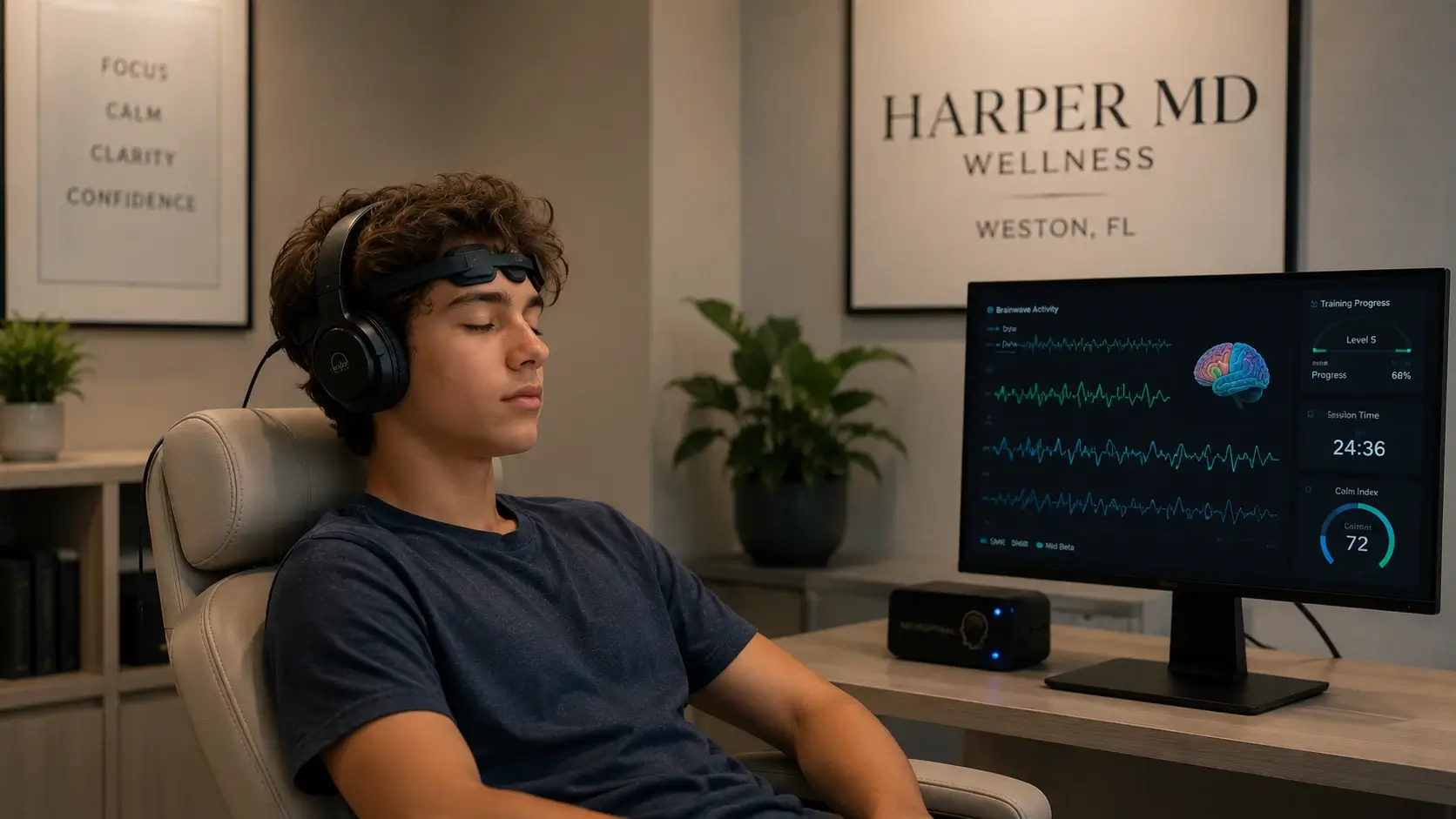
ADHD is the most thoroughly researched pediatric application of neurofeedback — and for good reason. The neurological profile of ADHD maps directly to what neurofeedback addresses: excess theta activity in the frontal lobe, insufficient beta regulation, and the resulting difficulty sustaining attention and managing impulse control.
The question most Weston parents are asking when they arrive at Harper MD is not whether their child has attention difficulties. That's already clear. The question is whether medication is the only path — or whether there is a credible, evidence-based alternative that addresses the root neurological pattern rather than chemically managing it.
The honest answer is: neurofeedback is a legitimate, evidence-supported option for children with attention difficulties — particularly those with mild to moderate presentations, those whose parents are concerned about stimulant side effects, and those for whom medication has produced incomplete results.
A 2023 study published in Frontiers in Human Neuroscience found that neurofeedback enhanced cognitive performance in healthy adults through EEG-based alpha regulation, with results that improved with learning rate and self-paced training — suggesting the brain's neuroplasticity actively drives the gains. See: Uslu & Vögele, Frontiers in Human Neuroscience, 2023.
For children whose ADHD hasn't responded fully to other approaches — or whose parents want to start with a non-pharmacological option — neurofeedback offers a path that trains the brain's own regulatory capacity rather than substituting external chemical support for it.
What the Process Looks Like for Both Adults and Children
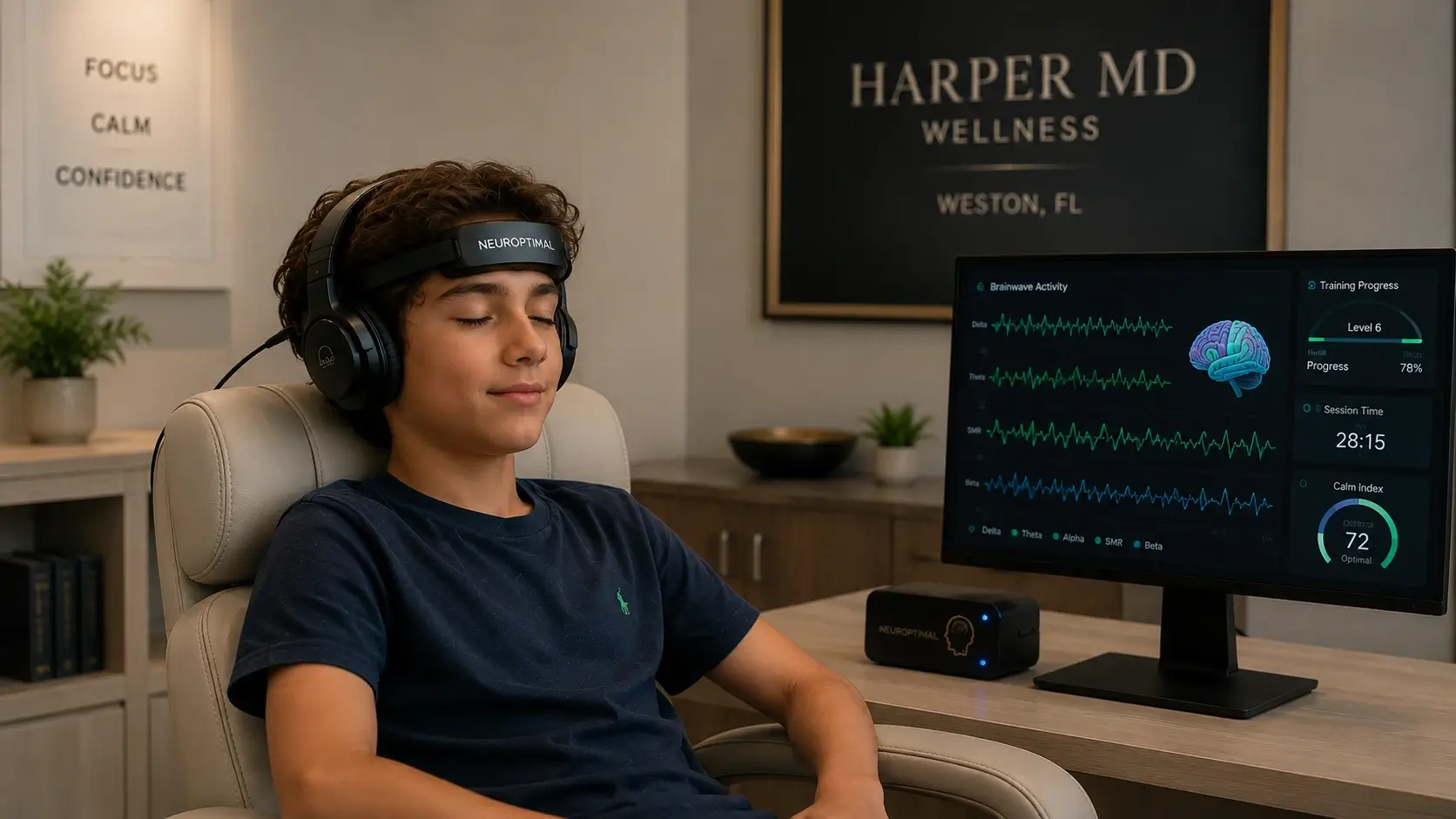
The neurofeedback protocol at Harper MD — delivered in partnership with SYMMETRY Neuro-Pathway Training — begins with a qEEG Brain Map. For a focus concern in either an adult or a child, the map typically reveals where theta is overactive and where beta regulation is insufficient. The training protocol is built around correcting those specific patterns in the regions where they're most problematic.
For adults, sessions are calm and focused — similar in feel to concentrated reading. For children, the protocol is typically delivered through engaging visual feedback — a format that holds their attention while their brain learns to regulate its own activity. Most children find the sessions far more accessible than traditional therapy.
Most patients — adults and children — notice early shifts within the first 6 to 10 sessions: more consistent attention, reduced mental fatigue, and for children, feedback from parents and teachers that something has changed. More complete and durable results typically emerge after 15 to 20 sessions.
Who Is the Right Candidate
•Adults 40–65 experiencing brain fog, inconsistent focus, or mental fatigue that isn't explained by sleep deprivation or obvious lifestyle factors
•Children ages 6–18 diagnosed with or suspected of ADHD whose parents want a drug-free or complementary approach
•Students whose academic performance doesn't reflect their capability — and whose parents believe a focus or regulation issue is the limiting variable
•Adults whose cognitive changes coincide with hormonal shifts and who want to address both the neurological and hormonal dimensions simultaneously
•Teens who are resistant to traditional therapy and whose parents are looking for an approach that doesn't require verbal engagement or emotional disclosure
To understand what your or your child's Brain Map would actually show — and whether neurofeedback is the right next step — the starting point is an evaluation at Harper MD.
Book at harpermd.mybodysite.com/harper-md-booking-page or contact us at harpermd.com/contact-us.
Frequently Asked Questions
Is neurofeedback as effective as medication for ADHD in children? Research suggests neurofeedback produces meaningful improvements in attention and hyperactivity in children with ADHD, with effects that can persist after the training protocol ends — which is generally not the case with medication alone. For mild to moderate presentations, it is a credible evidence-based option. For more severe presentations, it may be most effective as a complement to other approaches. An evaluation will help clarify what makes the most sense for your child's specific situation.
How long before my child's focus improves? Most parents and teachers notice early changes within 6 to 10 sessions — improved attention at home or in class, reduced frustration, more consistent follow-through on tasks. More significant and durable improvement typically emerges after 15 to 20 sessions. The timeline depends on the degree of brainwave dysregulation identified in the initial Brain Map.
My doctor said my cognition is fine. Why do I still feel foggy? Standard cognitive assessments measure performance at a single point in time under low-stress conditions. They do not capture the brainwave regulation capacity that determines how reliably that performance holds under real-world demand. A qEEG Brain Map provides a different kind of picture — one that reflects how your brain is actually regulating itself across contexts, not just whether you can perform well when asked to try.
External Citation: Uslu & Vögele — Neurofeedback enhances cognitive performance in healthy adults, Frontiers in Human Neuroscience 2023
External Citation: AbouAssaly et al. — Neurofeedback for COVID-19 Brain Fog, Cureus 2025
Harper MD Health & Wellness | 17150 Royal Palm Blvd #3, Weston, FL 33326 | (954) 338-1111 | harpermd.com
This content is for educational purposes only and does not constitute medical advice. Neurofeedback is not a treatment for or cure of any clinical diagnosis. Individual results vary. Consult a qualified healthcare provider to determine whether neurofeedback is appropriate for your or your child's specific situation.
