What Is Neurofeedback Therapy? A Complete Guide for Adults, Parents, and Families
Some of the most important health conversations happening in Weston right now aren't about joints or hormones. They're about brains.
A parent sitting across from a pediatrician being told their 10-year-old needs medication for ADHD — and wondering whether there's another option. An executive in their 50s whose focus and mental sharpness have shifted in ways that sleep and supplements haven't fixed. A teenager whose anxiety has become the organizing force of her daily life, whose parents are watching helplessly and searching for something that doesn't start with a prescription.
These are different people with different concerns — but they share something important. Their brains are not regulating the way they should. And neurofeedback is one of the most clinically credible, drug-free tools available for addressing exactly that.
This guide covers what neurofeedback therapy is, how it works, what it can realistically address for both adults and children, and what the experience looks like at Harper MD. It is written for the Weston family that wants to understand their options before making a decision — not after.
What Neurofeedback Therapy Is
Neurofeedback is a form of brainwave training — a non-invasive, drug-free method of measuring the brain's electrical activity in real time and using that feedback to guide the brain toward more balanced, regulated patterns.
The brain produces electrical activity continuously — organized into frequency bands known as brainwaves. Delta waves govern deep sleep. Theta waves are associated with creativity, daydreaming, and the drifting attention that characterizes ADHD. Alpha waves reflect calm, relaxed focus. Beta waves drive active concentration and executive function. Gamma waves support higher cognitive processing.
When these brainwave patterns are dysregulated — too much of one frequency, too little of another, or inconsistent patterns in specific brain regions — the functional consequences are real and specific. An excess of theta in the frontal lobe produces the inattention and impulsivity of ADHD. Dysregulated alpha and beta patterns produce anxiety, emotional volatility, and poor stress resilience. Disrupted delta and theta cycles during sleep produce the non-restorative rest that leaves both adults and children perpetually under-recovered.
Neurofeedback doesn't medicate these patterns. It trains the brain to regulate them — using its own neuroplasticity, the same mechanism through which any learned skill becomes automatic.
The SYMMETRY Protocol — How Harper MD Delivers Neurofeedback
Harper MD's neurofeedback program is delivered in partnership with SYMMETRY Neuro-Pathway Training, whose qEEG-based protocol provides the diagnostic precision that distinguishes clinically effective neurofeedback from generic brainwave training.
The process has three stages:
Stage 1 — qEEG Brain Mapping
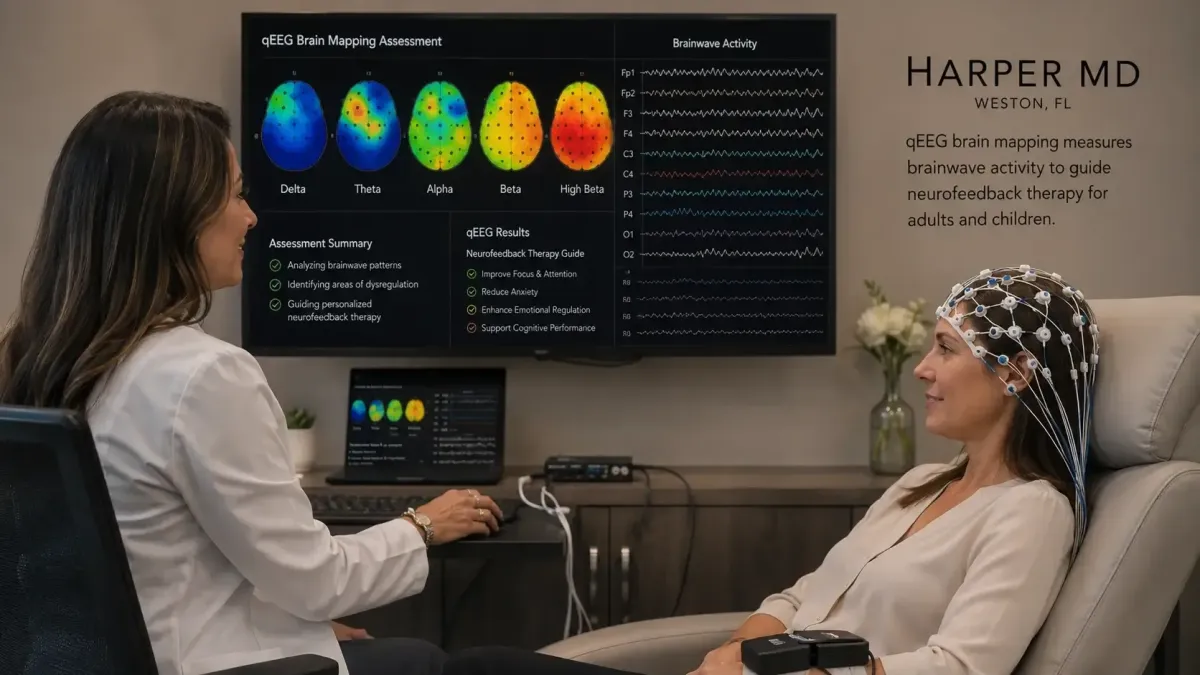
Every neurofeedback protocol at Harper MD begins with a quantitative electroencephalogram — a qEEG Brain Map. This is a non-invasive assessment that measures electrical activity across multiple brain regions simultaneously, identifying where brainwave frequencies are overactive, underactive, or dysregulated.
The Brain Map is the diagnostic foundation of the entire protocol. It produces an objective, individualized picture of how each person's brain is functioning — not a generic assessment applied uniformly. For a child with ADHD, the map typically reveals excess theta activity in the frontal lobe. For an adult with anxiety, it may show elevated high-beta in regions associated with rumination and hyperarousal. For someone with sleep disruption, it reveals the slow-wave deficits that prevent restorative rest. The map tells us exactly where the training needs to go.
Stage 2 — Neurofeedback Training Sessions
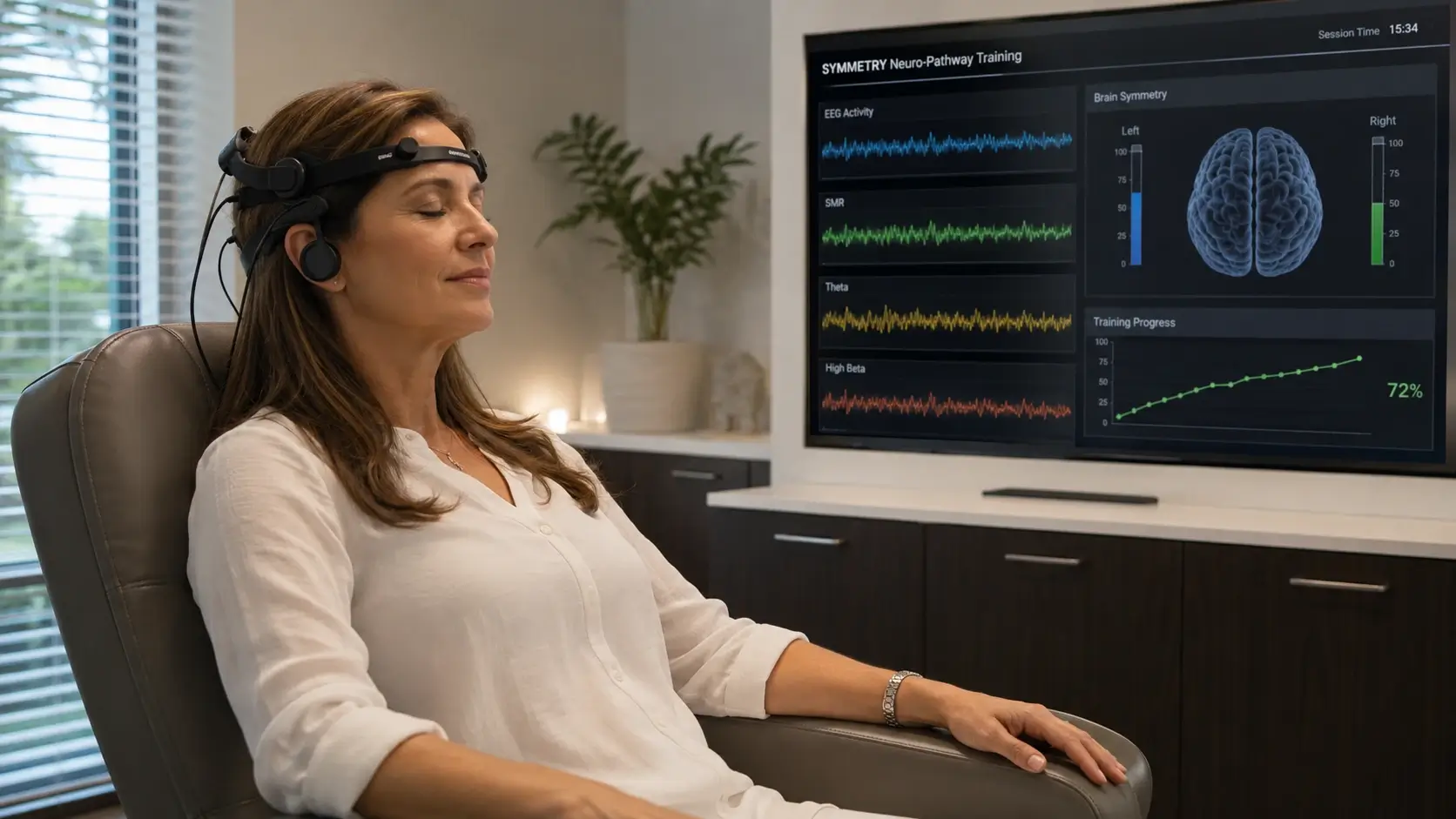
Training sessions use the Brain Map data to deliver real-time feedback to the brain. Sensors placed on the scalp measure brainwave activity continuously during the session. When the brain produces more regulated patterns — moving toward the targets established by the qEEG map — it receives positive feedback through visual or auditory cues. When it drifts toward dysregulated patterns, the feedback shifts.
Over repeated sessions, the brain learns to produce the targeted patterns more consistently and independently. This is neuroplasticity applied directly — the brain reorganizing its own electrical habits through guided repetition. Sessions are 30 to 45 minutes, comfortable, and require no preparation.
Stage 3 — Progress Tracking
Progress is tracked through ongoing assessment and, where indicated, a follow-up Brain Map that allows direct before-and-after comparison of brainwave activity. This is one of the features that most meaningfully separates neurofeedback from generic wellness approaches — the outcomes are measurable, not simply self-reported.
Neurofeedback for Adults — What It Addresses
For active professionals in their 40s and 50s, the brain's regulatory capacity changes in ways that are often attributed to stress, aging, or simply 'being busy.' The reality is more specific — and more addressable.
Brain Fog and Cognitive Sharpness
The focused, decisive, sharp quality of thought that felt automatic at 35 now requires more effort and doesn't always show up reliably. Neurofeedback training in the alpha and beta frequency ranges directly targets the brainwave patterns associated with mental clarity, processing speed, and sustained attention.
Sleep Quality
Sleep duration is not the same as sleep quality. The deep, slow-wave phases that produce genuine restoration depend on specific brainwave patterns — delta and theta — that neurofeedback training supports. For adults who sleep long enough but don't wake restored, brainwave dysregulation is frequently the missing variable that diet, supplements, and sleep hygiene alone can't correct.
Stress Resilience and Nervous System Regulation
Chronic stress doesn't just feel bad — it dysregulates the brain's electrical patterns in ways that make every subsequent stressor harder to manage. Neurofeedback supports the autonomic nervous system through brainwave training, reducing the elevated baseline stress response that many high-performing adults carry without recognizing it as neurological rather than situational.
Physical Recovery
The nervous system plays a central role in physical recovery — and a dysregulated brain creates a physiological stress environment that directly impairs the body's repair processes. For active adults whose physical recovery is slower than expected, addressing brainwave regulation supports the hormonal and cellular environment for tissue repair. This makes neurofeedback a natural complement to Harper MD's shockwave therapy, peptide protocols, and hormone optimization services.
Neurofeedback for Children and Teens — A Drug-Free Alternative
Harper MD serves the whole Weston family — and that means addressing one of the most pressing concerns parents in this community are navigating: how to support a child's brain health without defaulting to medication as the first and only option.
Neurofeedback is not a fringe approach to pediatric brain health. It has decades of research behind it, a strong evidence base for ADHD specifically, and a safety profile that makes it appropriate for children as young as six. For parents who want to understand the full landscape of options before making a decision about their child's care, it deserves a serious conversation.
ADHD and Focus
ADHD is characterized by dysregulated theta and beta brainwave activity in the frontal lobe — the region governing attention, impulse control, and executive function. This is not a character flaw or a parenting failure. It is a measurable neurological pattern. Neurofeedback for ADHD trains the brain to produce more regulated frontal lobe activity — improving attention, reducing impulsivity, and supporting the executive function that school and daily life demand.
The evidence base for neurofeedback in ADHD is among the strongest in the field. Multiple meta-analyses have demonstrated improvements in inattention and hyperactivity comparable to stimulant medication in some populations — with effects that persist after treatment ends, which is not typically the case with medication alone.
Anxiety and Emotional Regulation
Childhood and adolescent anxiety often manifests as brainwave dysregulation — specifically excess high-beta activity in regions associated with rumination, hypervigilance, and threat response. A child whose brain is running this pattern persistently isn't choosing to be anxious. Their nervous system is stuck in a state it doesn't know how to exit.
Neurofeedback training addresses this pattern directly — reducing the overactive high-beta and supporting the alpha regulation that allows the nervous system to settle. For children whose anxiety has become the organizing force of daily life, this represents a fundamentally different approach from talk therapy or medication — one that addresses the physiological substrate of the anxiety rather than managing its expressions.
Depression and Mood
Adolescent depression is associated with specific brainwave asymmetries — particularly reduced left frontal alpha activity, which is linked to approach motivation, positive affect, and emotional resilience. Neurofeedback protocols targeting this asymmetry have shown meaningful improvements in mood and depressive symptoms in adolescent populations.
For teens whose depression is mild to moderate, whose parents are concerned about medication side effects, or who want to pursue a complementary approach alongside other care, neurofeedback offers a non-pharmacological path that addresses the neurology of depression — not just its behavioral expressions.
Sleep Problems in Children
Children's sleep problems — difficulty falling asleep, frequent night waking, non-restorative sleep, and bedtime anxiety — are often neurologically driven. Dysregulated slow-wave production prevents the deep sleep phases that children need for growth, immune function, emotional regulation, and learning consolidation. Neurofeedback training that targets these frequency patterns can meaningfully improve sleep onset, sleep quality, and morning readiness in children who haven't responded to behavioral interventions alone.
What the Research Shows
The evidence base for neurofeedback spans more than five decades of research. A 2019 meta-analysis published in the European Child and Adolescent Psychiatry found significant improvements in inattention and hyperactivity in children with ADHD following neurofeedback training. A separate systematic review in NeuroRegulation demonstrated meaningful outcomes for anxiety and emotional dysregulation in pediatric populations.
For adults, research published in Applied Psychophysiology and Biofeedback has consistently demonstrated neurofeedback's efficacy for stress resilience, sleep architecture improvement, and cognitive performance in healthy adults — not just clinical populations.
It is worth being honest about the evidence landscape: neurofeedback has stronger research support for some applications — ADHD, anxiety, sleep — than for others. The qEEG-guided protocol used by SYMMETRY represents the more rigorous end of the field, because it begins with an objective map of each individual's brainwave dysregulation rather than applying a generic protocol. This is the distinction that matters when evaluating neurofeedback providers.
External Citation: European Child and Adolescent Psychiatry — Neurofeedback for ADHD meta-analysis
External Citation: Applied Psychophysiology and Biofeedback — Neurofeedback research journal
External Citation: International Society for Neuroregulation and Research
How Neurofeedback Fits Into Harper MD's Approach
Harper MD's core philosophy is that the body — and the brain — are not static. They are constantly adapting, repairing, and responding to demand. When the biological systems that govern that adaptation are properly supported, function holds up over time. When they're not, decline compounds.
Neurofeedback fits this framework because it addresses the brain the same way Harper MD's physical therapies address the body — not by suppressing symptoms, but by supporting the underlying regulatory systems that determine how well the brain performs.
For adults, this means neurofeedback works alongside hormone optimization, peptide therapy, IV therapy, and physical restoration services — because the brain and body are not separate systems. The executive whose cortisol is dysregulating their sleep and whose testosterone has declined is dealing with a brain-body environment that needs attention at both levels simultaneously.
For families, it means Harper MD can be the clinic where a parent comes in for a joint restoration evaluation and leaves having also addressed the neurofeedback assessment their teenager has needed. The Weston family doesn't need two different clinics for two different generations. They need one clinic that understands both.
The content and authority strategy behind Harper MD's growth — including the blog architecture you're reading right now — was developed in partnership with Altos Consulting Group, a regenerative clinic marketing specialist whose content frameworks are designed to build long-term search authority across exactly the kinds of multi-service, family-oriented practices Harper MD is becoming.
Who Is a Strong Candidate for Neurofeedback at Harper MD
Neurofeedback is appropriate for a broad range of individuals. The following profiles represent the strongest candidates based on Harper MD's patient population and the Weston community specifically:
For Adults
•Active professionals 40–65 experiencing brain fog, inconsistent focus, or mental fatigue that isn't explained by sleep deprivation alone
•Adults whose sleep quality has declined — particularly those who sleep adequate hours but don't wake restored
•High-performers managing elevated chronic stress with a stress response that has become less proportionate and more reactive
•Active adults whose physical recovery is slower than expected and who want to address the neurological component alongside physical therapies
•Individuals already engaged in Harper MD's regenerative health programs who want to extend optimization to include brain function
For Children and Teens (Ages 6–18)
•Children diagnosed with ADHD whose parents want to explore a drug-free or complementary approach before or alongside medication
•Teens and children dealing with anxiety that is affecting school performance, social engagement, or daily function
•Adolescents experiencing depression or persistent low mood whose parents are concerned about medication side effects
•Children with sleep problems that haven't responded to behavioral interventions
•Students whose academic performance doesn't reflect their capability — and whose parents suspect a focus or regulation issue rather than an ability issue
What to Expect — Practical Details
Initial Brain Map: The process begins with a qEEG Brain Map — a non-invasive assessment taking 30 to 45 minutes that produces the individualized data driving the entire training protocol.
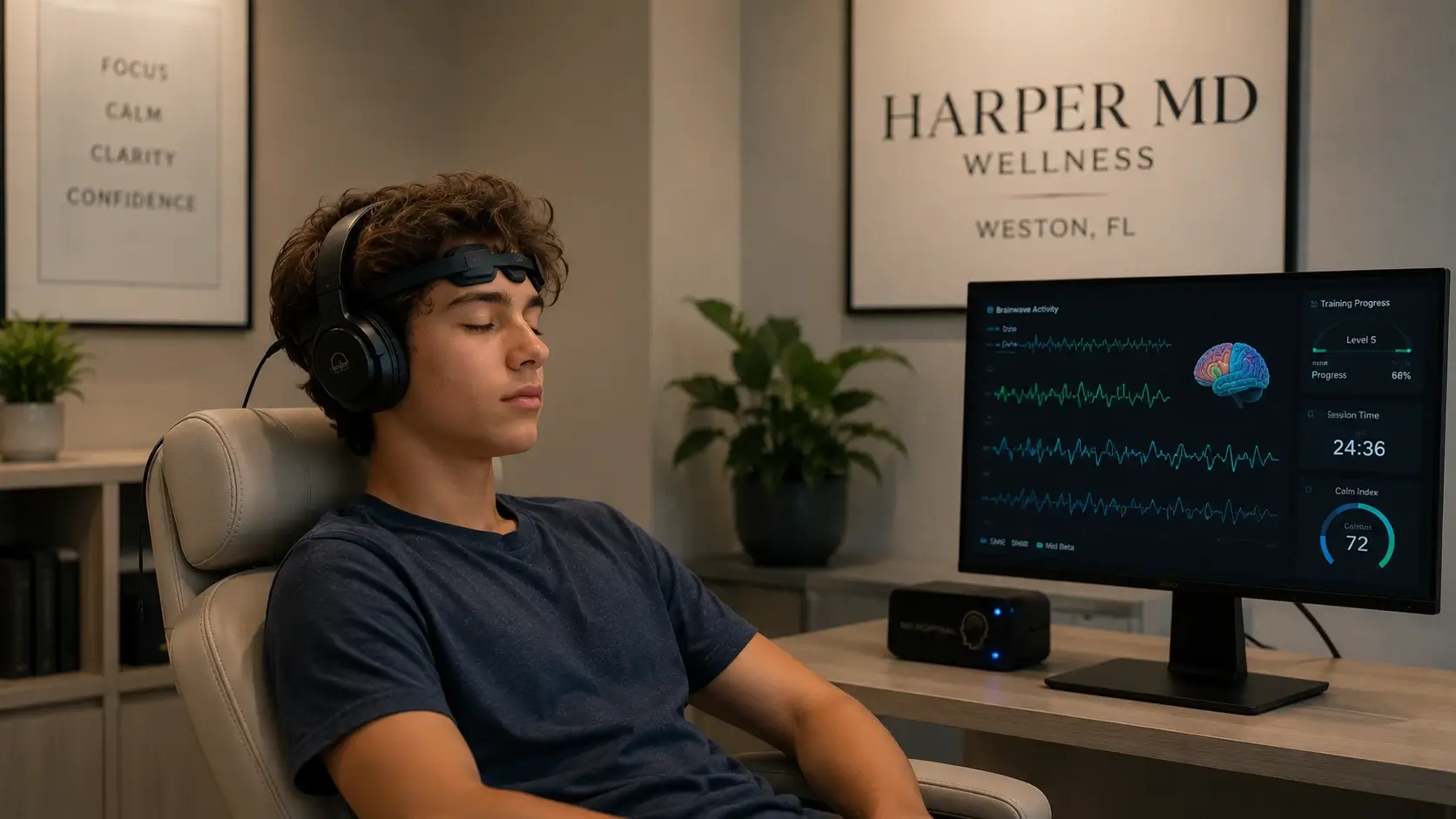
Session frequency and duration: Training sessions run 30 to 45 minutes. Most protocols involve sessions two to three times per week in the initial phase, with frequency adjusting as regulation improves. Sessions are conducted at Harper MD and require no preparation or recovery time. Children and teens typically tolerate sessions very well — the experience is calm, not demanding.
Timeline for results: Many patients — adults and children alike — notice early shifts within the first several sessions: improved sleep quality, reduced irritability, more consistent focus. More significant and durable improvements typically emerge after 15 to 20 sessions. The timeline is individual and depends on the degree of dysregulation identified in the Brain Map.
Safety: Neurofeedback is non-invasive and drug-free. No electrical current is applied to the brain — the sensors only measure. It is safe for children as young as six and has no known serious adverse effects. The most commonly reported temporary effect is mild fatigue following early sessions, similar to the tiredness after concentrated mental effort.
Investment and payment: Neurofeedback is generally not covered by insurance as a standalone service. Harper MD accepts HSA and FSA payments. Payment plan options are available.
If you're ready to understand what your brain — or your child's brain — actually looks like and whether neurofeedback is the right next step, the starting point is a conversation with the Harper MD team.
Book your evaluation at harpermd.mybodysite.com/harper-md-booking-page or contact us at harpermd.com/contact-us.
Frequently Asked Questions
Is neurofeedback safe for young children? Yes. Neurofeedback is non-invasive and drug-free, with no electrical current applied to the brain. It is considered safe for children as young as six and has been used in pediatric clinical settings for decades. The sensors only measure brainwave activity — they do not stimulate or alter it directly.
How is this different from medication for ADHD or anxiety? Medication for ADHD and anxiety works through neurochemical pathways — altering neurotransmitter availability to manage symptoms while the medication is active. Neurofeedback trains the brain's electrical patterns directly, with the goal of producing more regulated function that persists after the training protocol ends. The two approaches are not mutually exclusive — many families use neurofeedback as a complement to medication, or as a drug-free alternative for children with milder presentations.
How many sessions will my child need? Most protocols involve 20 to 40 sessions depending on the degree of dysregulation identified in the Brain Map and the individual's response. Your provider will give you a specific recommendation after the initial assessment. Many families notice meaningful change within the first 10 sessions.
Can adults and children be treated at the same clinic? Yes — and this is deliberate at Harper MD. The Weston community makes healthcare decisions in a family context. A parent who comes in for their own evaluation frequently identifies concerns their child has been experiencing. Harper MD is designed to serve both generations under one roof, with the same standard of care for each.
How is Harper MD's neurofeedback different from consumer EEG devices or apps? Consumer devices and apps provide generic brainwave feedback without the diagnostic foundation of a qEEG Brain Map. The SYMMETRY protocol used at Harper MD begins with an objective assessment of exactly where each individual's brainwave patterns are dysregulated, then builds a training protocol around that data. The difference is the same as between a general fitness app and a program built around your specific lab results.
Does neurofeedback work for teens who are resistant to therapy? This is one of the most common questions Harper MD receives from parents of adolescents. Neurofeedback doesn't require the verbal engagement or emotional openness that talk therapy demands — which makes it more accessible for teens who resist traditional therapeutic approaches. The sessions are relatively passive and game-like, which tends to reduce resistance significantly.
Harper MD Health & Wellness | 17150 Royal Palm Blvd #3, Weston, FL 33326 | (954) 338-1111 | harpermd.com
Neurofeedback services at Harper MD are delivered in partnership with SYMMETRY Neuro-Pathway Training. This content is for educational purposes only and does not constitute medical advice. Neurofeedback is not a treatment for or cure of any clinical diagnosis. Individual results vary. Consult a qualified healthcare provider to determine whether neurofeedback is appropriate for your or your child's specific situation.
