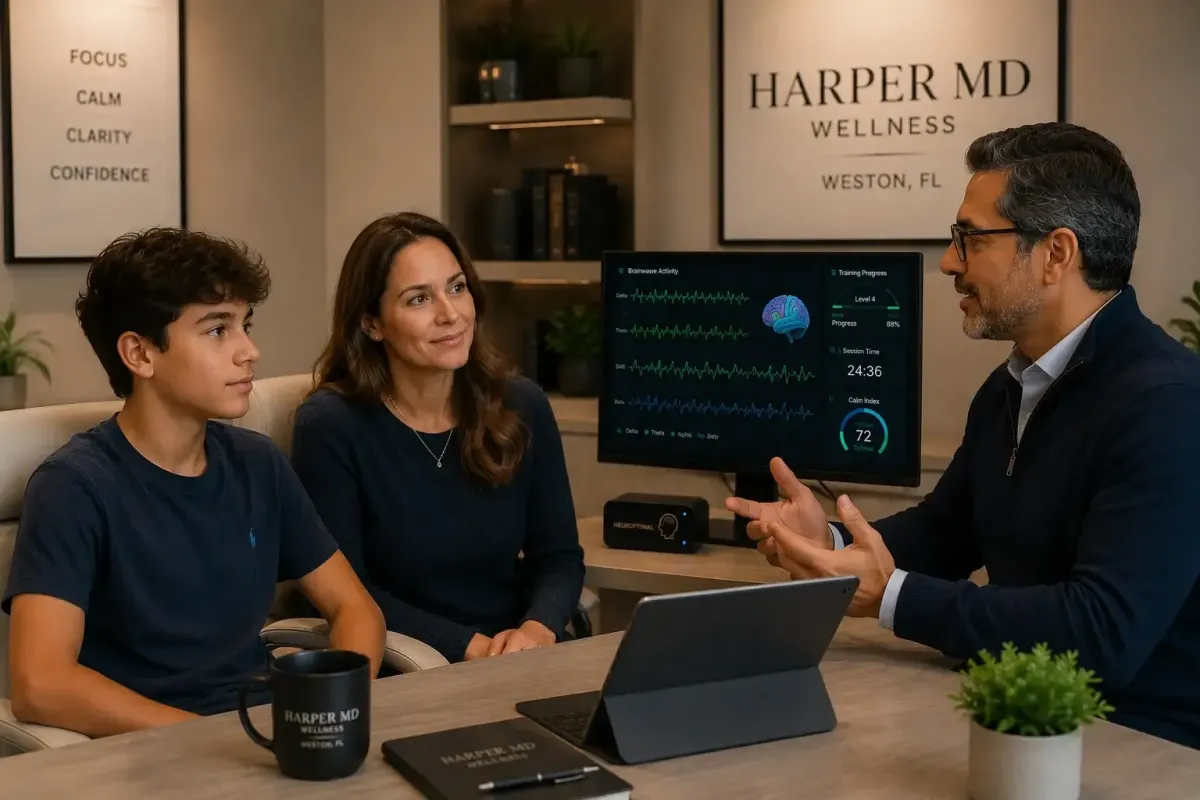
Anxiety, Stress, and an Overactive Nervous System — What Neurofeedback Does for Adults and Children
Anxiety is not a weakness. It is not a thinking problem. And for a growing number of adults and children, it is not primarily a problem that responds to more talk, more coping strategies, or — for many parents considering their children's options — more medication.
Anxiety is, at its neurological core, a nervous system regulation problem. The brain is running electrical patterns that keep it in a state of hyperarousal — scanning for threat, unable to fully settle, producing the subjective experience of worry, tension, and dread as a downstream consequence of its own dysregulated activity.
Neurofeedback addresses this at the source. Not by teaching someone to think differently about their anxiety. Not by chemically altering their neurochemistry. By training the brainwave patterns that are keeping the nervous system in a state it doesn't know how to exit.
This blog is part of Harper MD's neurofeedback content series. For a complete overview of what neurofeedback therapy is, how the qEEG Brain Map works, and what the SYMMETRY protocol involves for both adults and families, read our full guide: What Is Neurofeedback Therapy? A Complete Guide for Adults, Parents, and Families at harpermd.com/post/what-is-neurofeedback-therapy.
The Neurology of Anxiety — What's Actually Happening
The brain's anxiety response involves two intersecting systems: the limbic system, which generates the emotional and physiological fear response, and the prefrontal cortex, which is supposed to evaluate that response and regulate it. When the prefrontal cortex is functioning well — when its brainwave activity is properly regulated — it acts as a brake on the limbic system's alarm response. When it isn't, the alarm runs without adequate oversight.
In anxious adults and children, qEEG Brain Maps consistently reveal excess high-beta activity — particularly in the right frontal and temporal regions — associated with rumination, hypervigilance, and the persistent sense that something is wrong. This pattern keeps the nervous system in a state of readiness that has no off switch. The person isn't choosing to be anxious. Their brain is generating the neurological conditions for anxiety continuously.
Neurofeedback training targets this pattern directly — reducing the overactive high-beta and reinforcing the alpha regulation that allows the nervous system to settle. The goal is not relaxation on demand. It is a brain that regulates its own activity more efficiently — producing appropriate alert responses when warranted and settling when they're not.

For Adults — Chronic Stress and the Nervous System That Won't Reset
For active professionals in their 40s and 50s, anxiety often doesn't look like clinical anxiety disorder. It looks like a baseline tension that doesn't fully resolve. A stress response that's become disproportionate — situations that used to be manageable now trigger more reactivity than they should. A nervous system that stays activated long after the immediate pressure has passed.
This is the presentation that neurofeedback is particularly well-suited for: not acute crisis, but the chronic low-level dysregulation that accumulates in high-performing adults over years of demand without adequate neurological recovery.
The specific patterns that drive this presentation — excess high-beta, insufficient alpha regulation, autonomic nervous system imbalance — are measurable through a qEEG Brain Map and addressable through targeted neurofeedback training. The result is a nervous system that responds more proportionately, recovers more quickly, and maintains a lower baseline activation between demands.
For adults whose stress response is compounded by hormonal changes — declining testosterone or estrogen affecting cortisol regulation and emotional resilience — neurofeedback works most effectively as part of a plan that addresses both the neurological and hormonal environment simultaneously.
For Children and Teens — When Anxiety Becomes the Organizing Force of Daily Life
Childhood anxiety is one of the most common and most undertreated conditions in the Weston community — and one of the areas where parents feel most acutely the tension between wanting to help and not wanting to medicate.
Anxiety in children and teens manifests differently than in adults. It may look like refusal — refusing school, refusing social situations, refusing activities that used to be normal. It may look like physical symptoms — stomachaches, headaches, and complaints that appear before anxiety-provoking situations. It may look like emotional volatility — disproportionate reactions to small frustrations that reflect a nervous system already running at capacity.
Underneath these presentations is frequently the same neurological pattern: excess high-beta activity in regions associated with threat response, insufficient frontal regulation, and a nervous system that has learned to operate in a state of constant readiness.
A study published in NeuroRegulation found that neurofeedback was as effective as cognitive behavioral therapy (CBT) in reducing anxiety in children and adolescents with generalized anxiety disorder — and more effective than CBT specifically on state anxiety measures. See: Neurofeedback Training and CBT for GAD in Children and Adolescents, NeuroRegulation.
For parents who have tried therapy with partial results, or whose child is resistant to the verbal engagement that therapy requires, neurofeedback offers something different: a non-verbal, physiologically-based approach that trains the nervous system directly rather than trying to manage anxiety through cognitive reframing alone.
Neurofeedback vs. Other Anxiety Approaches — Where It Fits
vs. Medication: Anti-anxiety medications — SSRIs, benzodiazepines, beta-blockers — manage the neurochemical and physiological expressions of anxiety while they're active. They do not retrain the brainwave patterns that drive the anxiety response. Neurofeedback addresses those patterns directly, with the goal of producing more regulated nervous system function that persists after the training ends.
vs. Talk therapy / CBT: Cognitive behavioral therapy addresses the thought patterns and behavioral responses associated with anxiety — and it is effective for many patients. It does not directly address the neurological substrate that generates the anxiety experience. For patients whose anxiety has a strong physiological component — the nervous system that won't settle regardless of what they think about — neurofeedback addresses the layer that CBT doesn't reach.
vs. Mindfulness and relaxation techniques: These approaches support nervous system regulation in a general sense and are valuable adjuncts to any anxiety management plan. They do not produce the specific, targeted brainwave changes that neurofeedback training drives through qEEG-guided feedback. Neurofeedback is more precise — addressing the specific frequency patterns and brain regions that are dysregulated in each individual.
What to Expect
The qEEG Brain Map at the start of the protocol will identify the specific anxiety-related brainwave patterns most relevant to each patient — adult or child. From there, the training targets those patterns directly.
Most patients — adults and children — notice early changes within 6 to 10 sessions: a lower baseline tension, fewer episodes of disproportionate reactivity, improved sleep quality (which compounds quickly when the nervous system begins to settle). More complete regulation typically emerges after 15 to 20 sessions as the brain's new patterns become more established.
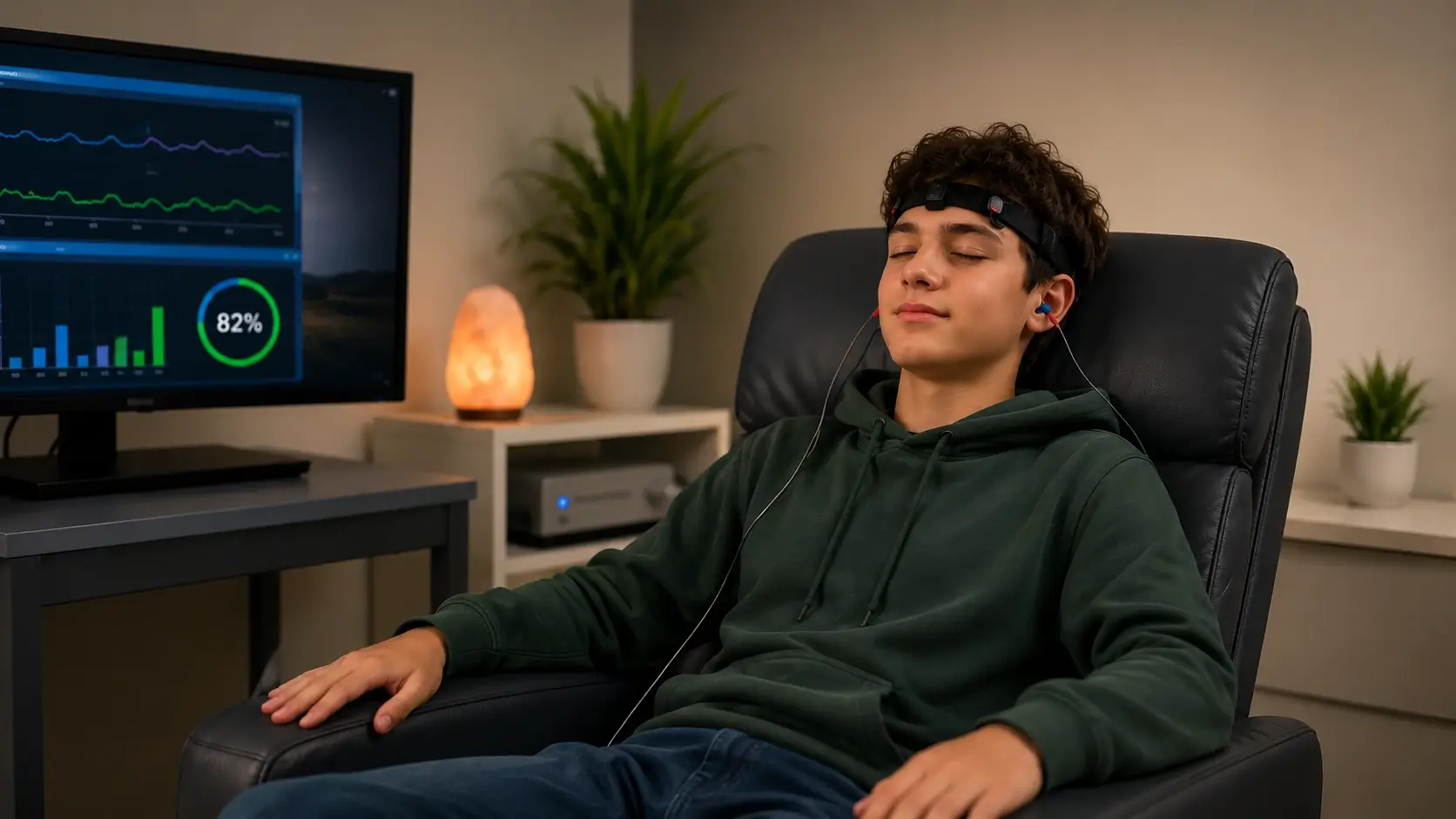
For children, the process is accessible and non-threatening — the feedback is delivered through engaging visuals, not through verbal processing or emotional disclosure. Most children who are resistant to traditional therapy find neurofeedback significantly more approachable.
Book an evaluation at Harper MD: harpermd.mybodysite.com/harper-md-booking-page.
Frequently Asked Questions
Can neurofeedback replace medication for anxiety in children? For some children — particularly those with mild to moderate anxiety presentations — neurofeedback is a credible drug-free alternative. For others, it works best as a complement to medication, addressing the neurological patterns that medication manages chemically. Harper MD evaluates each child's picture individually and makes recommendations based on what makes clinical sense — not a fixed preference for or against medication.
My child has tried therapy without much improvement. Would neurofeedback be different? Potentially, yes — because it operates at a different level. Therapy addresses thought patterns and behavioral responses. Neurofeedback addresses the neurological substrate that generates the anxiety experience. For children whose anxiety has a strong physiological component that hasn't responded to cognitive or behavioral approaches, neurofeedback addresses the layer that those approaches can't reach.
How does neurofeedback help adults with stress differently from meditation or breathwork? Meditation and breathwork support general nervous system regulation and are valuable practices. Neurofeedback is more targeted — it uses a qEEG Brain Map to identify the specific brainwave patterns driving dysregulation in each individual, then trains those patterns directly through real-time feedback. The specificity of the intervention is the key difference from general relaxation approaches.
External Citation: Neurofeedback vs CBT for anxiety in children and adolescents — NeuroRegulation
External Citation: Systematic review and meta-analysis of neurofeedback for PTSD — Frontiers in Psychiatry 2024
Harper MD Health & Wellness | 17150 Royal Palm Blvd #3, Weston, FL 33326 | (954) 338-1111 | harpermd.com
This content is for educational purposes only and does not constitute medical advice. Neurofeedback is not a treatment for or cure of any clinical diagnosis. Individual results vary. Consult a qualified healthcare provider to determine whether neurofeedback is appropriate for your or your child's specific situation.
