BPC-157 for Injury Recovery and Tissue Repair — What the Research Says and What to Expect
If you've been researching peptides for recovery, you've almost certainly come across BPC-157. It is currently the most searched individual peptide globally — and for active adults dealing with joint issues, tendon damage, or soft tissue injuries that haven't fully resolved, the volume of attention it's receiving reflects a real clinical need.
But BPC-157 also exists in a space where marketing has outpaced clear explanation. It gets described in terms that range from scientifically accurate to wildly overstated — and the regulatory picture is genuinely complex in ways that deserve honest acknowledgment rather than dismissal.
This blog covers what BPC-157 actually is, what the research supports, where the evidence is still developing, and what a medically supervised approach looks like for the Harper MD patient. For a broader overview of peptide therapy and how this fits into a complete treatment plan, see our guide at https://harpermd.com/post/what-is-peptide-therapy
What BPC-157 Is
BPC-157 stands for Body Protection Compound-157. It is a synthetic peptide derived from a sequence of amino acids found naturally in human gastric juice — a protein that the body produces in the stomach as part of its own protective and repair mechanisms.
The peptide consists of 15 amino acids. In its natural context, it is part of the body's tissue defense system — the gastric environment where it occurs natively is one of the most physiologically demanding in the body, and the compounds that survive there tend to have robust biological activity.
BPC-157 is not a hormone. It does not directly stimulate growth hormone or testosterone. Its mechanism is distinct from the GH-releasing peptides used for body composition and recovery — it acts more locally and specifically, targeting the tissue repair environment at the site of damage rather than the systemic hormonal infrastructure.
What the Research Actually Shows
The honest summary of BPC-157's evidence base is this: it is one of the most extensively studied peptides in preclinical research, with a consistent and compelling body of animal data — and limited but promising early human data. This distinction matters for how it's discussed and how it should be approached.
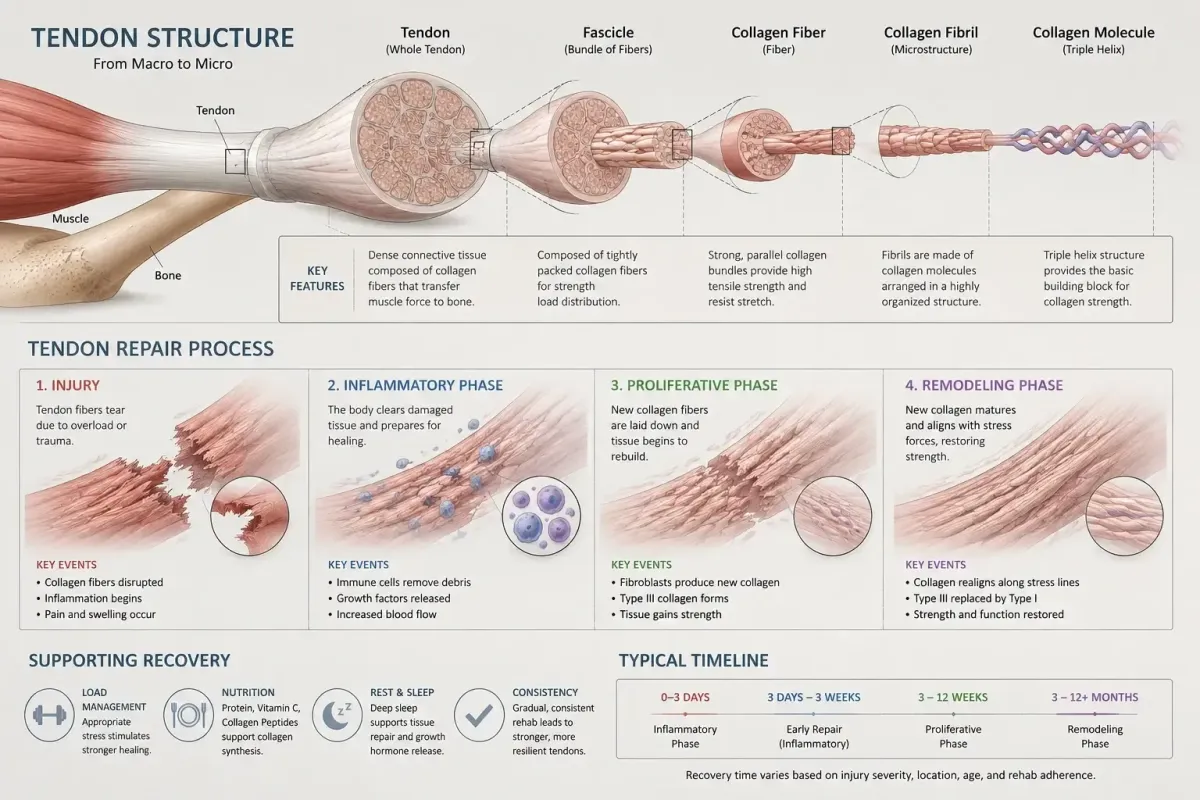
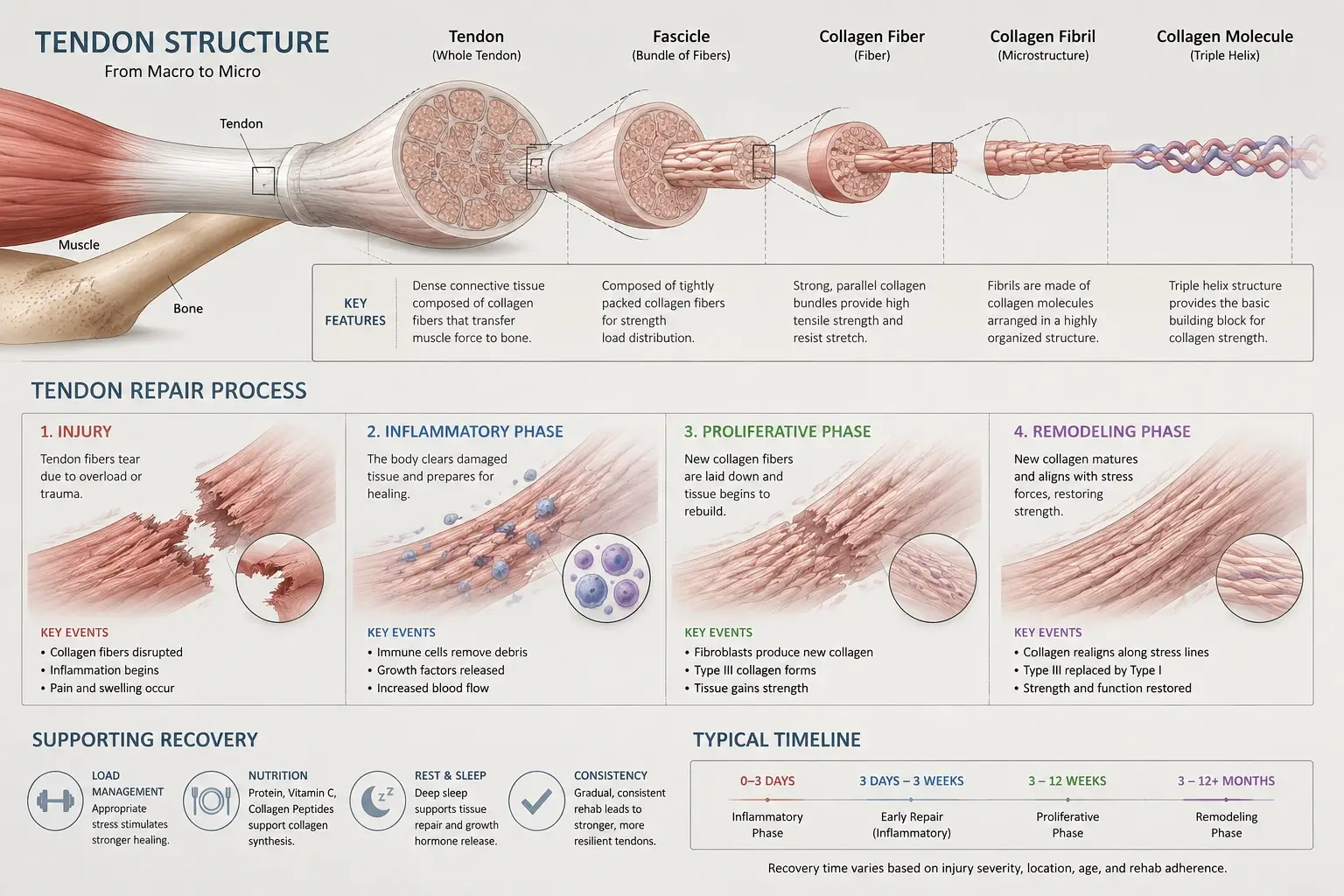
Tendon and ligament repair. Multiple animal studies have demonstrated accelerated tendon healing with BPC-157 — including faster cellular proliferation at the injury site, improved collagen organization, and earlier restoration of tensile strength. The mechanism involves upregulation of growth hormone receptor expression at the injury site, enhanced blood vessel formation (angiogenesis), and increased fibroblast activity. For the active adult with a chronic tendon issue, these mechanisms are directly relevant.
Muscle tissue repair. BPC-157 has shown accelerated healing of muscle tears in preclinical models — including improved satellite cell activation, which is the cellular mechanism of muscle repair. It also appears to reduce the fibrotic scarring that can compromise the quality of healed muscle tissue.
Joint and cartilage support. Animal studies have demonstrated BPC-157's effects on cartilage repair and joint inflammation — reducing the inflammatory cytokine environment that degrades joint tissue over time and supporting the structural repair of cartilage in damaged joint models.
Gut tissue repair. BPC-157 has one of its strongest evidence profiles for gastrointestinal tissue — accelerating healing of gastric ulcers, intestinal damage, and gut inflammation in multiple animal models. For active adults dealing with gut health issues alongside their physical concerns, this is a relevant secondary benefit.
Neurological and vascular effects. More recent research has examined BPC-157's effects on nerve healing and vascular repair — both areas with potential relevance for recovery from injury and the maintenance of tissue health over time.
The important caveat — one that Harper MD states honestly rather than glosses over — is that large-scale, randomized controlled trials in humans are not yet available for BPC-157. The preclinical evidence is extensive and consistently positive. Human clinical data is limited. This is why it is not FDA-approved for any therapeutic use, and why the regulatory environment around it has tightened in 2026.
For active adults, the practical question is: does the preclinical evidence, the mechanism, and the clinical experience at responsible medical practices provide sufficient basis for supervised use? At Harper MD, the answer is yes — with appropriate evaluation, compliant sourcing, and honest expectation-setting.
How BPC-157 Is Used at Harper MD
BPC-157 is not prescribed at Harper MD as a standalone protocol applied uniformly. It is used as part of an evaluated, individualized plan for patients whose clinical picture — chronic joint or tendon issues, recovery limitations, or soft tissue damage — makes it a clinically appropriate addition.
Delivery. BPC-157 is most commonly administered via subcutaneous injection near the site of concern — which allows it to act locally on the tissue being targeted. It can also be delivered systemically via injection in the abdomen, and oral BPC-157 is used specifically for gut-related applications. Your provider will determine the most appropriate delivery method based on what's being addressed.
Protocol length. Most BPC-157 protocols run four to eight weeks, depending on the severity and chronicity of the condition being addressed. For acute injury applications, four to six weeks is a typical starting point. For chronic conditions, a longer protocol or a repeat course may be appropriate.
Combination use. BPC-157 frequently works alongside shockwave therapy for joint and tendon conditions — shockwave addressing the local tissue repair environment mechanically, while BPC-157 supports the biological repair cascade systemically and locally. It is also commonly used alongside GH-releasing peptides, which improve the broader tissue repair environment within which BPC-157 acts.
![Close-up representation of a joint area being addressed through peptide therapy, representing the tendon and soft tissue repair applications of BPC-157 at Harper MD]](https://assets.cdn.filesafe.space/BjdJQzXsoMWLKLk4nhQL/media/6a09d69f2e98e28fa1628cbd.webp "Close-up representation of a joint area being addressed through peptide therapy, representing the tendon and soft tissue repair applications of BPC-157 at Harper MD]")
How BPC-157 Fits Into a Broader Joint Restoration Plan
For the Harper MD patient dealing with a chronic joint or tendon issue — a knee that hasn't fully healed, a shoulder that remains limited after PT, or an Achilles that flares with every training block — BPC-157 addresses a specific and meaningful gap in the treatment landscape.
Conventional approaches to these conditions treat the symptom — rest reduces load, cortisone reduces inflammation, PT improves mechanics. None of them directly address the tissue repair environment at the cellular level. BPC-157 does. It creates a more favorable biological environment for the repair processes that conventional treatments stimulate indirectly.
At Harper MD, this means BPC-157 is often discussed in the same evaluation conversation as shockwave therapy — because the two approaches address the same underlying problem from complementary angles. Shockwave therapy delivers a targeted mechanical stimulus that restarts the repair cascade locally. BPC-157 supports the cellular environment that determines how effectively that cascade proceeds.
For patients who have already completed a shockwave protocol with partial improvement, or who are preparing for one and want to optimize the tissue environment in advance, BPC-157 is a natural addition to the plan.
Learn more about Harper MD's joint restoration approach at harpermd.com/services/joint-restoration-relief, or see our complete peptide therapy guide at harpermd.com/therapies/peptide-therapy. Book an evaluation at https://harpermd.mybodysite.com/harper-md-booking-page
Who Is a Strong Candidate
•Active adults with chronic tendon conditions — Achilles tendinopathy, patellar tendinopathy, lateral epicondylitis — that have persisted despite conventional care
•Patients managing joint pain or soft tissue damage where the repair environment has stalled
•Active adults preparing for or recovering from orthopedic procedures who want to support the tissue repair process
•Patients already using shockwave therapy or cellular regenerative therapy who want to extend the repair signal to the systemic level
•Individuals with gut health concerns alongside their musculoskeletal issues — BPC-157's gastrointestinal effects are a meaningful secondary benefit for this profile
Frequently Asked Questions
Is BPC-157 FDA-approved? No. BPC-157 is not FDA-approved for any therapeutic use in humans. It is used in medically supervised settings through licensed compounding pharmacies under physician oversight. Harper MD sources BPC-157 exclusively through compliant, licensed compounding facilities and prescribes it as part of an evaluated, monitored protocol.
Is it safe? The preclinical safety profile of BPC-157 is favorable — animal studies have not demonstrated significant toxicity at therapeutic doses. Human data is limited but consistent with the animal profile. The primary safety considerations at Harper MD are compliant sourcing — which eliminates the contamination and purity risks of unregulated online products — and appropriate evaluation to identify any contraindications.
How quickly will I notice results? For acute tissue applications, many patients notice changes within two to four weeks. For chronic conditions that have been present for a year or more, the timeline is longer — the tissue environment has had more time to entrench, and restoration is a gradual process. Your provider will set realistic expectations based on your specific condition and its history.
Can BPC-157 be used alongside other peptides? Yes. BPC-157 is frequently combined with TB-500 for enhanced systemic tissue repair, and with GH-releasing peptides like CJC-1295 and Ipamorelin that improve the broader cellular repair environment. The combination is determined by your evaluation and what it reveals about your specific picture.
Harper MD | 17150 Royal Palm Blvd #3, Weston, FL 33326 | (954) 338-1111 | harpermd.com
This content is for educational purposes only and does not constitute medical advice. BPC-157 is not FDA-approved for human therapeutic use. Individual results vary. Consult a qualified healthcare provider to determine whether peptide therapy is appropriate for your specific situation.
