Why Your Recovery Takes Longer Than It Used To — And What You Can Actually Do About It
It's one of the most common observations active adults make in their 40s and 50s — and one of the most dismissed.
The workout that used to leave you ready to go the next morning now takes two days to clear. The tennis match that felt fine during play leaves your knee stiff for a week. The round of golf that was never a physical challenge now means a sore shoulder for three days afterward. The soreness is deeper. It lingers longer. And the gap between what you used to bounce back from and what you're bouncing back from now keeps widening.
The standard response from conventional medicine is some version of: that's just what happens as you get older. Adjust your expectations. Dial back your activity. Manage it.
That answer isn't wrong, exactly. But it's incomplete — and for most active adults, it's not acceptable. Because the issue isn't that the body can't recover. The issue is that the biological systems that drive recovery are becoming less efficient. And that's something you can actually address.
What's Actually Happening When Recovery Slows
Slow recovery isn't a single problem. It's the combined effect of several biological changes that accumulate across the 40s and 50s — each one manageable in isolation, but significant when they compound.
Declining cellular repair efficiency. Every time you train or compete, you create microscopic tissue damage — in muscle fibers, tendons, and the connective tissue around joints. Recovery is the process of repairing and rebuilding that tissue. As you age, the cellular machinery that drives this process — including satellite cells in muscle tissue and fibroblasts in connective tissue — becomes less responsive and slower to mobilize. The damage accumulates faster than the repair can keep up.
Reduced tissue blood supply. Tendons and connective tissue already have limited blood supply compared to muscle. With age, that supply becomes more restricted — meaning repair resources arrive more slowly to the areas that need them most. This is a primary reason tendon injuries in particular become more persistent after 40.
Hormonal changes. Testosterone, growth hormone, and IGF-1 all play meaningful roles in tissue repair and recovery capacity. All three decline with age. Testosterone supports muscle protein synthesis and connective tissue integrity. Growth hormone drives cellular regeneration and tissue remodeling. When these hormones drop below optimal levels, the biological environment for recovery becomes less favorable — even in people who are training consistently and eating well.
Accumulated tissue damage. Decades of sport and physical activity leave a cumulative mark on tendons, cartilage, and the tissue surrounding joints. Many active adults in their 50s are managing not just current training load but the accumulated effect of previous injuries that never fully healed. This background damage raises the baseline from which recovery has to start — and lowers the ceiling of what the body can realistically repair after each session.
Chronic low-grade inflammation. As biological resilience declines, the body's inflammatory regulation becomes less precise. Recovery from training involves a controlled inflammatory response — the kind that triggers repair. But when systemic inflammation is chronically elevated, that signal becomes less targeted and the recovery process becomes less efficient.
Why This Matters More Than People Realize
Slow recovery isn't just an inconvenience. Over time, it's a compounding problem.
When recovery is slower than training demand, tissue damage accumulates faster than it's repaired. Joints that used to be resilient become gradually more compromised. Tendons that were once reliable develop the kind of chronic degeneration that is notoriously difficult to reverse. The active adult who pushes through slow recovery without addressing the underlying biology doesn't just feel worse — they are, incrementally, doing more damage than their body can keep up with.
The result, for many people in their 50s and 60s, is a shoulder that never fully healed, a knee that requires constant management, or an Achilles that has been 'almost right' for two years. These aren't isolated injuries. They're the downstream consequence of a recovery deficit that has been accumulating for years.
The good news is that the biological systems driving recovery are not fixed. They are responsive to the right interventions — including shockwave therapy, which directly addresses tissue-level repair in the areas where recovery has stalled.
Where Shockwave Therapy Fits Into the Recovery Picture
Shockwave therapy doesn't replace sleep, nutrition, or load management. Those fundamentals matter and they always will. What shockwave therapy does is address a specific and significant gap that those fundamentals can't fill on their own — the tissue-level repair environment in chronically stressed or damaged areas.
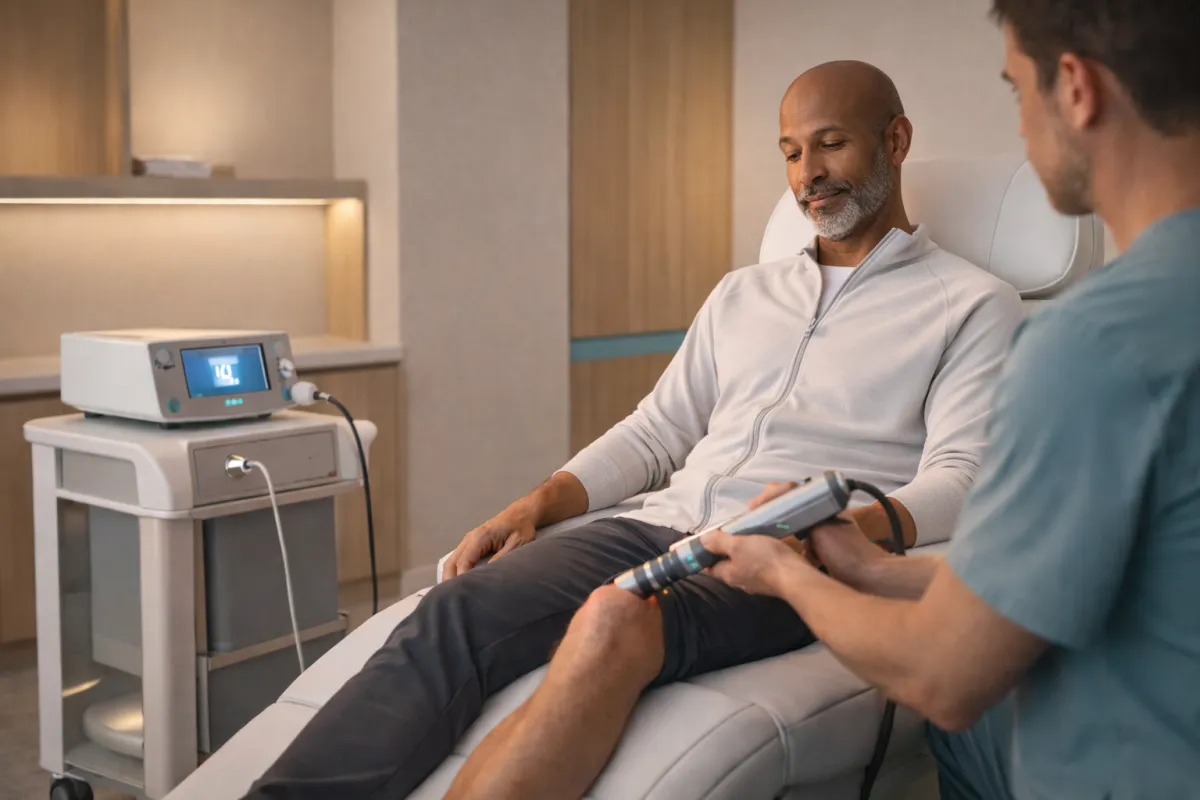
When the shockwave device is applied to a joint, tendon, or area of soft tissue damage, the acoustic pressure waves trigger a targeted biological response in exactly the tissue that has stalled in recovery. Specifically:
•Blood flow to the area increases — delivering the cellular repair resources that chronic tissue damage requires but can no longer reliably attract on its own
•Fibroblast activity is stimulated — activating the collagen production that rebuilds tendon and connective tissue quality
•The nerve fibers driving chronic pain signaling are modulated — reducing the baseline discomfort that compounds with every training session
•New blood vessel formation is promoted — improving the long-term vascular supply to tissue that has been under-resourced for years
The practical effect is a tissue environment that is actively repairing rather than slowly degrading — which means a body that can absorb training demand more effectively and recover more completely between sessions.
For active adults dealing with a specific joint or tendon that is clearly limiting their recovery, shockwave therapy addresses that target directly. For those whose recovery issues are more systemic — affecting multiple areas and connected to broader hormonal and cellular changes — shockwave therapy is often most effective as part of a wider plan that includes addressing the hormonal and cellular environment alongside the tissue-specific work.

The Difference Between Managing Slow Recovery and Addressing It
Most of the conventional advice around slow recovery in active adults falls into the management category. Train less. Rest more. Accept that your body is changing. Take more ibuprofen. This advice isn't entirely wrong — but it doesn't move the needle on the underlying biology.
Addressing slow recovery means looking at the specific biological mechanisms that are underperforming and applying targeted interventions that improve them. That might mean:
•Shockwave therapy applied to a tendon or joint that hasn't fully recovered from previous damage — restimulating the repair response at the tissue level
•Evaluation of hormonal status — particularly testosterone and growth hormone — to determine whether a decline in hormonal support is contributing to the recovery deficit
•Peptide therapy protocols that support tissue repair, cellular signaling, and recovery capacity at a systemic level
•IV therapy that provides the micronutrient and antioxidant support that tissue repair depends on but that diet alone often can't reliably deliver
These aren't separate strategies for separate problems. They're complementary tools that address the same underlying issue — a recovery capacity that has declined below what an active lifestyle demands — from different angles.
What a Realistic Approach Looks Like
Active adults in their 40s and 50s who are serious about maintaining their physical capability are not looking for a shortcut. They're looking for an honest, evidence-informed plan that addresses what's actually happening in their body — and gives them practical tools to stay ahead of decline rather than manage it after the fact.
At Harper MD, an evaluation for slow recovery starts with a thorough conversation about your training history, your current load and recovery patterns, the specific areas that are limiting you, and your goals. From there, the plan is built around your situation — not a generic protocol.
For some patients, the right starting point is shockwave therapy on a specific joint or tendon that is clearly the primary limiting factor. For others, the evaluation reveals a broader picture — hormonal changes, systemic cellular health, or multiple tissue issues — that warrants a more integrated approach.
Either way, the goal is the same: a body that recovers reliably enough to keep doing the things that matter to you. Not forever — but for significantly longer than the current trajectory suggests.
If your recovery has been the limiting factor in your training or your sport, an evaluation at Harper MD is a good starting point. Learn more at harpermd.com/therapies/shockwave-therapy or book directly at https://harpermd.mybodysite.com/harper-md-booking-page.
Frequently Asked Questions
Is slow recovery just a normal part of aging that I have to accept? Slower recovery is a real biological change — but 'accept it and manage it' is not the only option. The mechanisms driving slower recovery are responsive to targeted interventions. How much improvement is possible depends on the individual, the specific factors at play, and how proactively they're addressed.
How do I know if my slow recovery is a tissue issue versus a hormonal one? Often it's both. Tissue-level damage in specific joints or tendons and systemic hormonal changes frequently coexist in active adults over 45. An evaluation that looks at both — rather than treating each in isolation — tends to produce more complete results.
Can shockwave therapy help with general muscle soreness and fatigue? Shockwave therapy is most effective for targeted tissue conditions — specific tendons, joints, and areas of chronic soft tissue damage. For general recovery capacity, the broader picture of hormonal status, cellular health, and systemic support is more relevant. Harper MD evaluates both.
How many sessions would I need before noticing a difference? For targeted tissue conditions, most patients notice meaningful improvement within three to six sessions. The timeline for broader recovery improvements depends on the specific plan and the individual's baseline. Your provider will give you realistic expectations during your evaluation.
Harper MD | 17150 Royal Palm Blvd #3, Weston, FL 33326 | (954) 338-1111 | harpermd.com
This content is for educational purposes only and does not constitute medical advice. Individual results vary. Consult a qualified healthcare provider to determine whether shockwave therapy is appropriate for your specific situation.
