
What Is Medical Weight Loss? A Complete Guide for Active Adults Who Want to Address the Root Cause
Most active adults who arrive at a medical weight loss conversation have already done everything the conventional approach recommends. They've tracked calories. They've adjusted macros. They've increased training frequency. They've tried intermittent fasting. And the results — if they came at all — didn't hold, didn't go far enough, or required a level of sustained effort that wasn't compatible with the rest of their life.
The conventional model of weight management — eat less, move more — is not wrong. But for a significant portion of adults over 40, it is incomplete. Because the reason weight becomes harder to manage in midlife isn't primarily behavioral. It's biological. The hormonal and metabolic environment that governed body composition for decades has shifted — and no amount of caloric restriction compensates fully for a system that is no longer responding to the inputs it used to respond to.
Medical weight loss addresses that gap. Not by applying more of the same approach with physician oversight — but by evaluating and addressing the biological mechanisms that are making weight management resistant in the first place. For the right patient, it is one of the most meaningful interventions available. For the wrong patient — or in the wrong clinical context — it is simply a prescription handed out without the evaluation that makes it valuable.
This guide explains what medical weight loss actually involves, what distinguishes a genuinely physician-supervised program from a prescription-forwarding service, and how Harper MD's metabolic approach integrates with the broader regenerative health picture.
Why Weight Management Changes After 40
The metabolic shift that active adults experience in their 40s and 50s is real, documented, and driven by specific biological mechanisms — not lifestyle decline. Understanding what's actually happening makes it possible to address it effectively rather than simply working harder against a system that is working differently.
Hormonal Decline and Its Metabolic Consequences
Testosterone in men and estrogen in women both play direct roles in metabolic regulation — far beyond their reproductive functions. Testosterone supports lean muscle mass, suppresses visceral fat accumulation, and improves insulin sensitivity. As it declines through the 40s and 50s, the metabolic environment shifts: fat storage becomes easier, particularly around the midsection, and the muscle tissue that burns calories at rest becomes harder to maintain.
Estrogen in women regulates fat distribution, insulin sensitivity, and the inflammatory environment of metabolic tissue. The perimenopause and post-menopause transition — typically occurring between 45 and 55 — produces a metabolic shift that is often described by women as the most confusing and frustrating body change they've experienced. Not because they've changed what they're doing. Because the biology has changed underneath them.
Growth hormone — which declines at approximately 14 to 15 percent per decade after age 30 — is a primary regulator of visceral fat metabolism. As GH declines, the suppressive effect on visceral adipose tissue weakens. The midsection carries more fat not because of caloric surplus but because the hormonal environment that once kept it in check has diminished.
Insulin Resistance — The Central Metabolic Variable
Insulin resistance is the metabolic condition most directly associated with weight resistance in midlife — and the one most frequently underdiagnosed in active adults who don't consider themselves metabolically unhealthy.
When cells become resistant to insulin's signal, the body compensates by producing more insulin. Elevated insulin drives fat storage — particularly visceral fat — and makes fat mobilization during caloric restriction more difficult. The active adult who eats reasonably and trains consistently but can't shift the midsection is often dealing with insulin resistance that conventional caloric approaches don't address.
Insulin resistance is also progressive. Left unaddressed, it moves along a spectrum toward prediabetes and type 2 diabetes — conditions that are substantially more difficult to manage than the earlier insulin resistance that preceded them. Identifying and addressing it early is one of the most meaningful interventions in metabolic health — and one that requires lab work, not just scale weight.
Inflammation and the Metabolic Environment
Chronic low-grade inflammation — increasingly common in midlife adults, particularly those managing significant training loads alongside professional and personal stress — directly impairs metabolic function. Inflammatory cytokines interfere with insulin signaling, disrupt the hormonal environment, and create a metabolic backdrop that makes fat loss physiologically harder. Managing inflammation is not peripheral to a metabolic program — it is central to it.

What Medical Weight Loss Actually Is
The term 'medical weight loss' has been diluted by the volume of services now using it — from telehealth prescription services that send GLP-1 medications after a five-minute intake to legitimate physician-supervised programs that evaluate the patient's full metabolic picture before designing a protocol.
At Harper MD, medical weight loss is the latter. It begins with a comprehensive evaluation that goes well beyond BMI and a medication decision. It includes:
•Fasting insulin and glucose — to identify insulin resistance before it appears on standard metabolic panels
•Full hormonal panel — testosterone, estrogen, thyroid function, cortisol — to identify the hormonal contributors to weight resistance
•Inflammatory markers — CRP, homocysteine — to assess the metabolic inflammation environment
•IGF-1 and growth hormone markers — to evaluate the GH component of visceral fat accumulation
•Body composition assessment — distinguishing visceral fat from total weight, which determines both risk and the most appropriate intervention
•Comprehensive health history — medications, conditions, lifestyle factors that affect metabolic function and protocol design
From there, a protocol is built around what that picture shows. For some patients, the primary driver is hormonal — and addressing testosterone, estrogen, or GH alongside metabolic support produces the most complete result. For others, insulin resistance is the central variable and GLP-1 therapy is the most targeted intervention. For most, the picture is layered — and the protocol reflects that.
GLP-1 Therapy — What It Is and How It Works
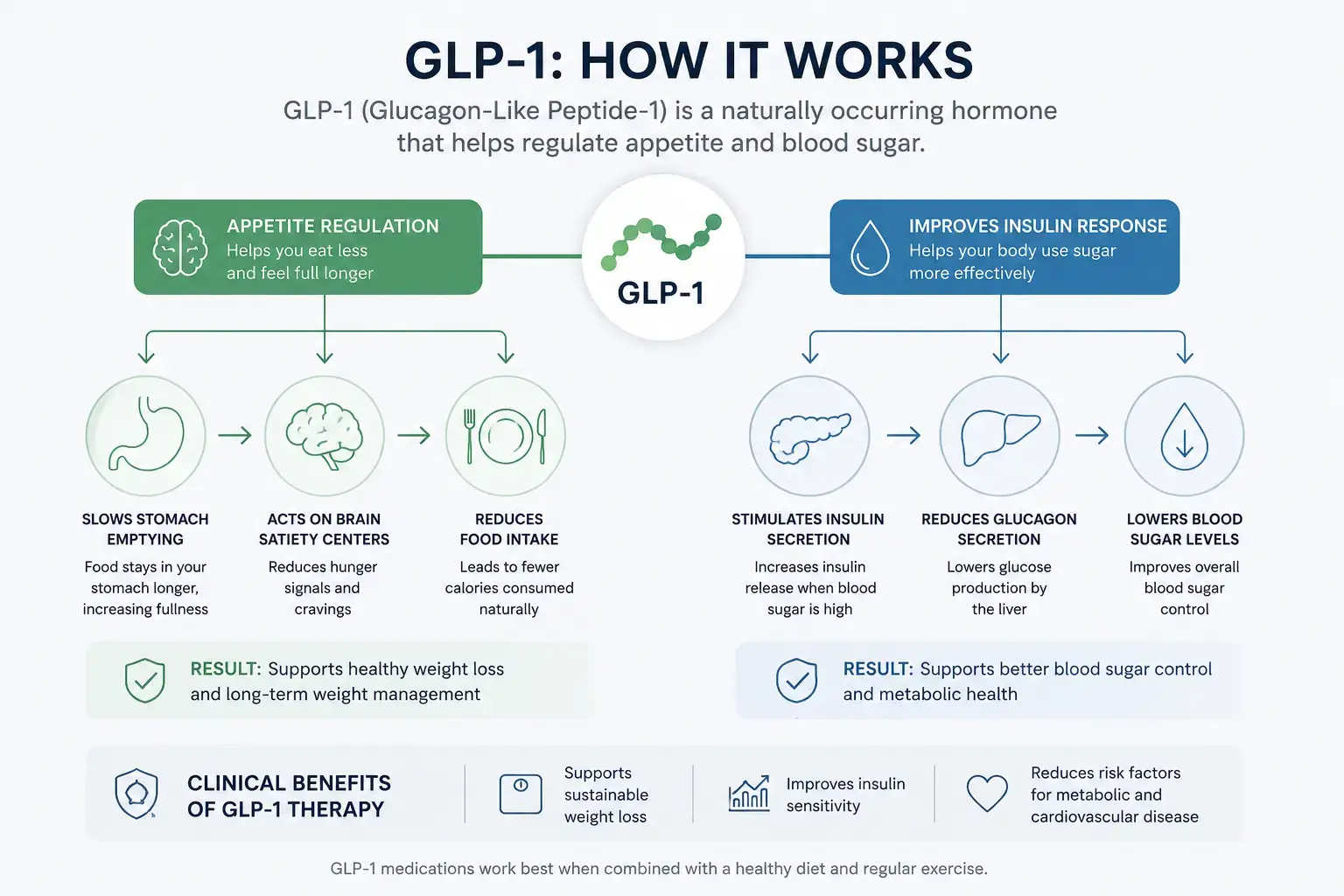
GLP-1 receptor agonists are currently the most clinically significant class of medications in metabolic weight management. They work by mimicking glucagon-like peptide-1 — a hormone naturally produced in the gut in response to food intake — which regulates appetite, slows gastric emptying, improves insulin secretion, and reduces glucagon output.
The practical effects for patients on a physician-supervised GLP-1 protocol include:
•Significant reduction in appetite and food noise — the persistent preoccupation with eating that drives overconsumption in insulin-resistant and hormonally shifted metabolic environments
•Improved insulin sensitivity — GLP-1 agonists directly improve the cellular response to insulin, addressing the resistance that drives fat storage
•Slowed gastric emptying — producing prolonged satiety from smaller meals
•Reduction in visceral fat — clinical trials have demonstrated meaningful reductions in visceral adipose tissue beyond what caloric restriction alone produces
•Cardiovascular benefit — the GLP-1 class has demonstrated cardiovascular risk reduction in high-risk populations, a secondary benefit that extends beyond the weight loss itself
GLP-1 therapy is not appropriate for everyone — and at Harper MD, it is not prescribed as a universal solution. Candidacy depends on the patient's metabolic picture, health history, and goals. Contraindications exist and are evaluated during the intake process. The medication is one tool in a broader metabolic plan — not a substitute for the evaluation that determines whether it's the right tool for the individual.
An important note on sourcing and compliance: The FDA removed semaglutide from its drug shortage list in early 2025, ending the enforcement discretion that had allowed compounded GLP-1 bulk programs. As of 2026, any GLP-1-based metabolic program must use FDA-approved branded medications with proper physician oversight. Harper MD operates within these parameters. Patients considering GLP-1 therapy through any provider should verify that the medications being offered are appropriately sourced.
Peptide Therapy and Metabolic Support
For active adults whose metabolic picture includes a significant GH and visceral fat component — which is common in the 48 to 62 age range — peptide therapy is a meaningful complement to GLP-1 protocols or hormonal optimization.
Tesamorelin is an FDA-approved growth hormone-releasing hormone analog with demonstrated efficacy for visceral fat reduction. Its mechanism is distinct from GLP-1 therapy — it targets visceral adipose tissue through the GH-IGF-1 axis rather than through appetite and insulin pathways. For patients whose midsection accumulation is driven primarily by GH decline rather than insulin resistance, Tesamorelin addresses the root mechanism more directly than a caloric approach.
CJC-1295 / Ipamorelin combination protocols restore the broader GH environment — improving sleep quality, supporting lean muscle maintenance, and creating a more favorable body composition environment within which dietary and GLP-1 interventions operate. For patients on GLP-1 therapy, GH peptide support helps preserve lean mass during the weight loss process — an important consideration, as rapid weight loss without adequate anabolic support can result in muscle loss alongside fat loss.
The integration of peptide therapy with GLP-1 protocols is one of the features that distinguishes Harper MD's metabolic program from standalone prescription services. The goal is not weight loss at any cost — it is body composition optimization that preserves the physical capability the active adult has built.
The Role of Hormone Optimization in Metabolic Weight Loss
For patients whose metabolic picture includes significant hormonal contributors — declining testosterone in men, estrogen and progesterone shifts in women — hormone optimization is not a secondary consideration to a metabolic program. It is a primary one.
Testosterone optimization in men addresses the lean mass and fat distribution components of the metabolic shift directly — and creates a more favorable environment for GLP-1 and peptide therapy to operate within. Men who pursue GLP-1 therapy without addressing a concurrent testosterone deficit often find that weight loss comes at the cost of muscle mass, because the anabolic support for lean tissue preservation isn't there.
Estrogen optimization in women addresses the fat distribution shift, insulin sensitivity changes, and inflammatory environment that accompany the menopausal transition. For women whose metabolic shift has coincided with perimenopause or post-menopause, addressing the hormonal component alongside metabolic therapy produces more complete and more durable results than either approach alone.
At Harper MD, the metabolic evaluation includes the hormonal picture — and the protocol reflects both. This is the integration that separates a genuine metabolic health program from a weight loss service.
What Harper MD's Metabolic Weight Loss Program Looks Like
Every patient who enters Harper MD's metabolic weight loss program begins with a comprehensive evaluation — the labs, health history, body composition assessment, and goal conversation described above. No protocol is designed before that picture is clear.
From the evaluation, a protocol is built that may include one or several of the following components, depending on what the individual's picture indicates:
•GLP-1 therapy — physician-prescribed, FDA-approved branded medications, monitored throughout the protocol
•Hormone optimization — testosterone for men, estrogen and progesterone for women, where hormonal deficit is a primary metabolic driver
•Peptide therapy — Tesamorelin and/or GH-releasing peptides for the visceral fat and lean mass components of the metabolic picture
•Nutritional guidance — specific to the patient's metabolic picture, not a generic caloric prescription
•Ongoing monitoring — labs at defined intervals, protocol adjustment based on response, and integration with any other Harper MD services the patient is engaged with
The program is not a fixed package. It is a plan built around the individual — and adjusted as that individual responds. The goal is not the fastest possible weight loss. It is the most durable, most complete metabolic improvement that leaves the patient's physical capability intact and their long-term health trajectory meaningfully improved.
Who Is a Strong Candidate
•Active adults 40–65 who are managing weight despite consistent training and reasonable nutrition — and want to understand the biological drivers rather than simply intensify effort
•Men and women whose weight and body composition have shifted meaningfully in the past two to five years in ways that coincide with hormonal changes
•Adults with insulin resistance, prediabetes, or metabolic syndrome who want a proactive, physician-supervised approach to reversing the trajectory
•Patients whose primary concern is visceral fat accumulation — the midsection shift — rather than total scale weight
•Active adults already engaged in Harper MD's regenerative health services who want to extend the optimization work to include metabolic health
•Individuals who have used consumer weight loss programs or unmonitored GLP-1 sources without adequate supervision and want a genuinely evaluated approach
Medical weight loss at Harper MD is not appropriate for patients seeking rapid weight loss without regard for muscle preservation, or for individuals whose weight concerns are primarily aesthetic without an underlying metabolic driver. The evaluation process determines candidacy — and we'll tell you directly if a different approach is more appropriate for your situation.

How This Fits Into the Broader Harper MD Philosophy
Metabolic health is not a standalone category at Harper MD. It is one dimension of the same biological picture that includes joint function, hormonal health, cellular repair capacity, and longevity. The active adult in their 50s who is managing weight, dealing with joint issues, experiencing hormonal changes, and noticing slower recovery is not dealing with four separate problems. They are dealing with one aging biological system expressing itself in multiple ways simultaneously.
Harper MD's approach addresses that system — not its symptoms in isolation. The metabolic program is designed to integrate with hormone optimization, peptide therapy, and physical restoration services because the patients who benefit most from each of those approaches are frequently the same person. Understanding the full picture is what makes any single intervention more effective.
If you're ready to understand what your metabolic picture actually looks like — and to have a direct conversation about what's driving what you're experiencing — an evaluation at Harper MD is the right starting point. Learn more at harpermd.com/services/metabolic-weight-loss or book directly at https://harpermd.mybodysite.com/harper-md-booking-page.
Frequently Asked Questions
Is medical weight loss just a GLP-1 prescription? Not at Harper MD. A GLP-1 prescription may be one component of a metabolic weight loss protocol — but it is never the starting point. The evaluation comes first. The protocol is built around what the evaluation reveals. For some patients, GLP-1 therapy is the most appropriate primary intervention. For others, hormonal optimization, peptide therapy, or a combination approach is more appropriate. The prescription follows the evaluation — not the other way around.
How is this different from telehealth GLP-1 services? Telehealth GLP-1 services typically involve a brief intake, a prescription, and ongoing medication delivery with minimal clinical oversight. Harper MD's program begins with comprehensive lab work, a thorough evaluation, and a protocol built around the individual's full metabolic and hormonal picture. Monitoring is ongoing and the protocol is adjusted based on response. The difference is clinical depth — and it produces meaningfully different outcomes.
Will I lose muscle mass on a GLP-1 protocol? Muscle loss is a real concern with rapid weight loss on GLP-1 therapy — and one that Harper MD addresses proactively. GH peptide support, adequate protein intake, and resistance training guidance are integrated into the protocol specifically to preserve lean mass during the weight loss process. This is one of the reasons physician supervision matters for this class of medication.
How long does a medical weight loss program last? It depends on the individual's goals, starting point, and response. Initial protocols are typically designed for three to six months, with evaluation at regular intervals. Some patients continue on maintenance protocols after reaching their primary goals. The program duration is determined by what the patient needs — not a fixed timeline.
Do I need to stop my current medications or supplements before starting? Not necessarily — but your full medication and supplement list is reviewed during the evaluation, as certain combinations require specific consideration. Do not stop any current medications before speaking with your provider.
Harper MD | 17150 Royal Palm Blvd #3, Weston, FL 33326 | (954) 338-1111 | harpermd.com
This content is for educational purposes only and does not constitute medical advice. Individual results vary. GLP-1 therapy and other medical weight loss interventions involve individual candidacy considerations that must be evaluated by a qualified healthcare provider. Harper MD uses only FDA-approved branded GLP-1 medications under physician supervision.
