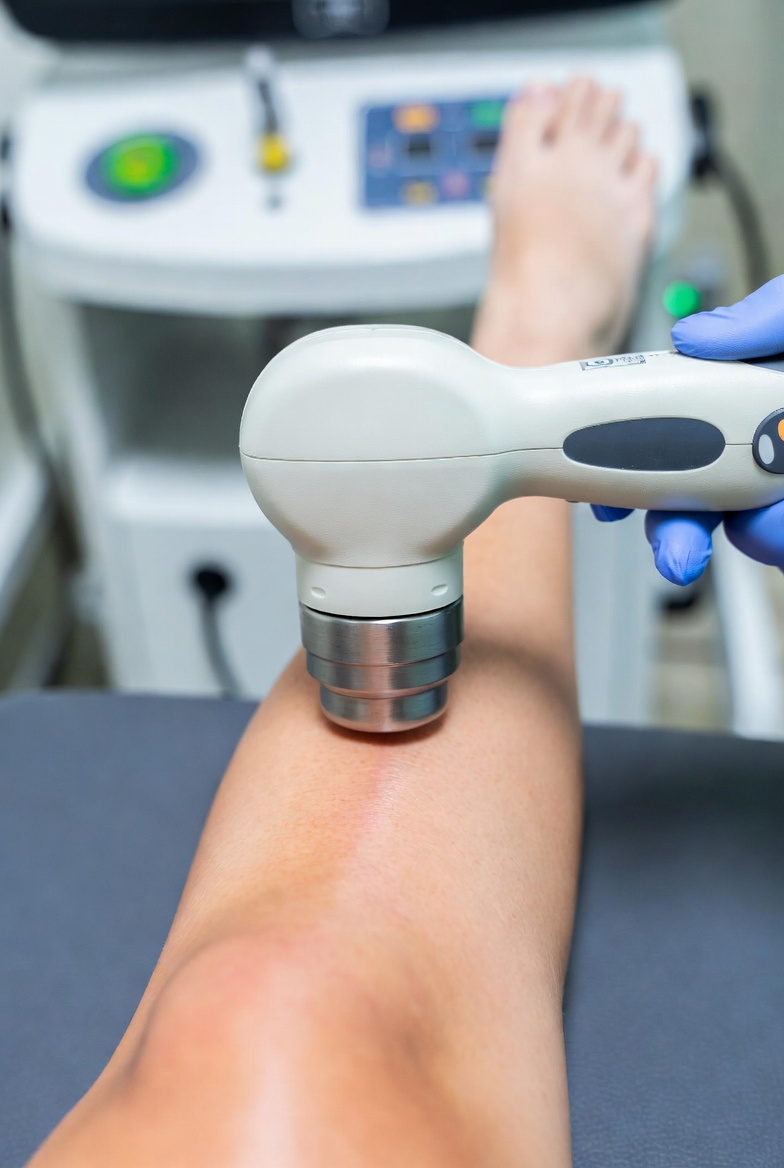
Tennis Elbow, Achilles Tendinopathy, and Chronic Tendon Pain — What Shockwave Therapy Actually Does
Tendon pain has a particular kind of persistence that sets it apart from most other musculoskeletal problems. It doesn't announce itself dramatically. It builds gradually. And once it settles in, it tends to stay — outlasting the rest periods, the stretching protocols, the braces, and the injections that were supposed to resolve it.
If you play tennis, pickleball, golf, or any sport that places repetitive demand on the elbow, wrist, heel, or Achilles, you've likely encountered this firsthand. The lateral elbow that flares up every time you grip. The Achilles that's stiff every morning and takes twenty minutes to loosen up. The patellar tendon that complains on stairs and makes running feel like a negotiation.
These are tendinopathies — conditions characterized by the degeneration of tendon tissue rather than simple inflammation — and they are among the conditions where shockwave therapy has the strongest clinical evidence and the most predictable outcomes.
This blog explains why chronic tendon conditions are so resistant to conventional treatment, what shockwave therapy does at the tissue level, and which specific conditions it addresses most effectively.
Why Tendon Conditions Are So Resistant to Standard Treatment
To understand why shockwave therapy works for tendon conditions, it helps to understand why so many other treatments don't — or don't last.
The conventional treatment sequence for tendinopathy typically looks like this: rest, then physical therapy, then a cortisone injection if PT doesn't resolve it. For acute tendon irritation, this sequence often works. For chronic tendinopathy — the kind that has been present for months or years — it frequently doesn't. Here's why.
Tendinopathy is not primarily an inflammatory condition. The term 'tendinitis' implies inflammation as the core problem. But research over the past two decades has shifted the understanding significantly. Chronic tendon conditions are more accurately described as tendinopathy — a degenerative process in which the structural integrity of the tendon has been compromised at the tissue level. Treating it with anti-inflammatory strategies, including cortisone, addresses a secondary feature rather than the primary pathology.
Tendons have poor native blood supply. Unlike muscle tissue, tendons rely on a limited vascular network for repair resources. This means that even when the body is trying to repair damaged tendon tissue, the delivery of cellular repair resources is slow and restricted. In chronically damaged tendons, this supply becomes even more compromised — creating a tissue environment that is structurally degraded and poorly equipped to rebuild itself.
The acute repair window closes. The body's most active repair response occurs in the weeks immediately following an injury. Once that window closes and the tissue hasn't fully healed, the acute repair cascade winds down. What remains is compromised tissue that the body has effectively deprioritized. Conventional treatments — rest, stretching, bracing — don't reopen that window. Shockwave therapy does.
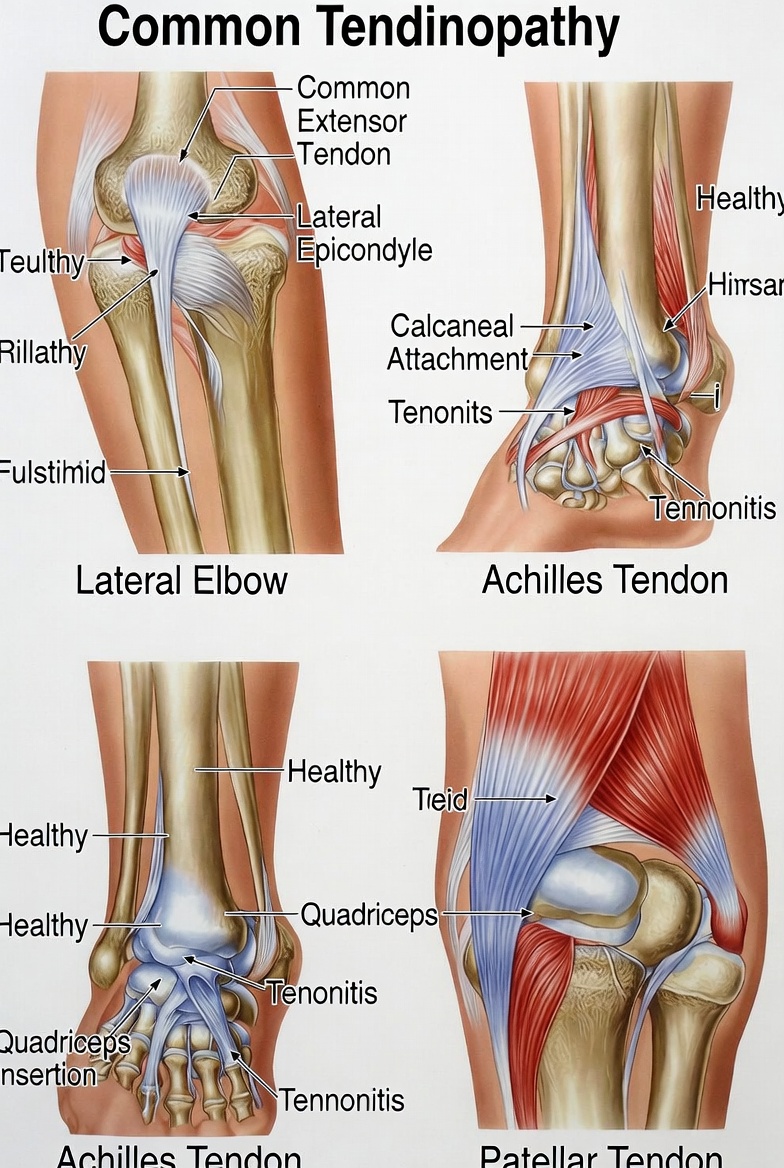
The Four Tendon Conditions Shockwave Therapy Addresses Best
Tennis Elbow (Lateral Epicondylitis). Despite the name, tennis elbow affects far more people who have never picked up a racket than those who have. It's characterized by degeneration of the extensor tendons where they attach to the lateral epicondyle — the bony prominence on the outside of the elbow. The condition is driven by repetitive gripping, twisting, and wrist extension under load. Shockwave therapy has one of its strongest evidence bases here. Multiple randomized controlled trials have demonstrated significant improvement in pain and grip strength following shockwave protocols, with outcomes that outperform cortisone injection at six and twelve month follow-up.
Achilles Tendinopathy. The Achilles is the largest and strongest tendon in the body — and one of the most frequently compromised in active adults. Achilles tendinopathy typically presents as pain and stiffness at the back of the heel, worst in the morning and after periods of inactivity, that warms up with movement but returns after load. It affects runners, cyclists, tennis and pickleball players, and anyone who puts sustained demand on the lower leg. Shockwave therapy is considered a first-line non-surgical intervention for Achilles tendinopathy that hasn't responded to eccentric loading protocols and conservative management.
Patellar Tendinopathy (Jumper's Knee). Pain at the front of the knee, just below the kneecap, that flares with loading activities — stairs, squatting, jumping, prolonged sitting — is the hallmark of patellar tendinopathy. It's common in active adults whose sport involves repetitive knee flexion under load: cyclists, pickleball and tennis players, hikers, and anyone who trains with lower body movements. Shockwave therapy delivers acoustic energy directly to the patellar tendon, restimulating the repair cascade in tissue that has degraded through repeated demand without adequate recovery.
Plantar Fasciitis. Technically not a tendinopathy but a fasciiopathy — degeneration of the plantar fascia rather than a tendon — plantar fasciitis responds to shockwave therapy through the same mechanism. Pain at the heel, worst with the first steps of the morning, that eases with movement and returns after prolonged loading, is the defining pattern. For cases that have persisted beyond three to six months and haven't resolved with stretching, orthotics, or injections, shockwave therapy is now recognized as a primary non-surgical option with strong clinical support.
What Shockwave Therapy Does to Tendon Tissue
The mechanism of shockwave therapy for tendon conditions is specific and worth understanding clearly — because it's different from anything else in the conventional treatment toolkit.
When the shockwave device is applied over a degenerated tendon, the acoustic pressure waves penetrate to the target tissue and trigger a series of biological responses:
•Mechanical disruption of degenerated tissue — the pressure waves break up disorganized collagen and calcific deposits that have accumulated in the degraded tendon, clearing the way for organized repair
•Stimulation of fibroblast activity — fibroblasts are the cells responsible for producing new collagen. In chronically degenerated tendons, their activity has slowed. Shockwave therapy restimulates them directly
•Increased local vascularization — new blood vessel formation improves the delivery of repair resources to tissue that has been chronically under-supplied, addressing one of the core structural disadvantages of tendon healing
•Re-initiation of the acute repair response — the mechanical stimulus of shockwave therapy signals to the body that active repair is needed in this tissue, effectively reopening the repair window that conventional rest-based approaches cannot
•Pain modulation — acoustic waves influence the nerve fibers responsible for chronic pain transmission in and around the tendon, providing relief through neurological as well as structural mechanisms
The result is a tendon that is actively rebuilding its structural integrity — not simply being rested or managed.
Who Is the Right Candidate
Shockwave therapy for tendon conditions is most appropriate for active adults whose tendinopathy has become chronic — meaning it has been present for three months or more and has not fully resolved with conventional care.
Strong candidates typically share some combination of the following:
•A tendon condition — tennis elbow, Achilles tendinopathy, patellar tendinopathy, plantar fasciitis — that has been present for three or more months
•Previous treatment with rest, eccentric loading protocols, physical therapy, or cortisone that provided partial or temporary relief
•A desire to return to full activity — sport, training, or daily function — without the constant management the current condition requires
•No contraindications to shockwave therapy, including active infection or treatment near a growth plate
For acute tendon conditions — in the first four to six weeks after onset — shockwave therapy is generally not indicated. The acute inflammatory phase needs time to run its course before the tendon repair environment is appropriate for shockwave stimulation.
An evaluation at Harper MD will confirm whether your condition and its timeline make you a strong candidate, and what a realistic protocol and outcome look like for your specific situation.
What the Treatment Process Looks Like
A shockwave therapy protocol for chronic tendon conditions typically involves three to six sessions spaced one week apart. Sessions run 15 to 20 minutes for most tendon applications. No anesthesia is required, and there is no recovery period between sessions and normal daily activity.
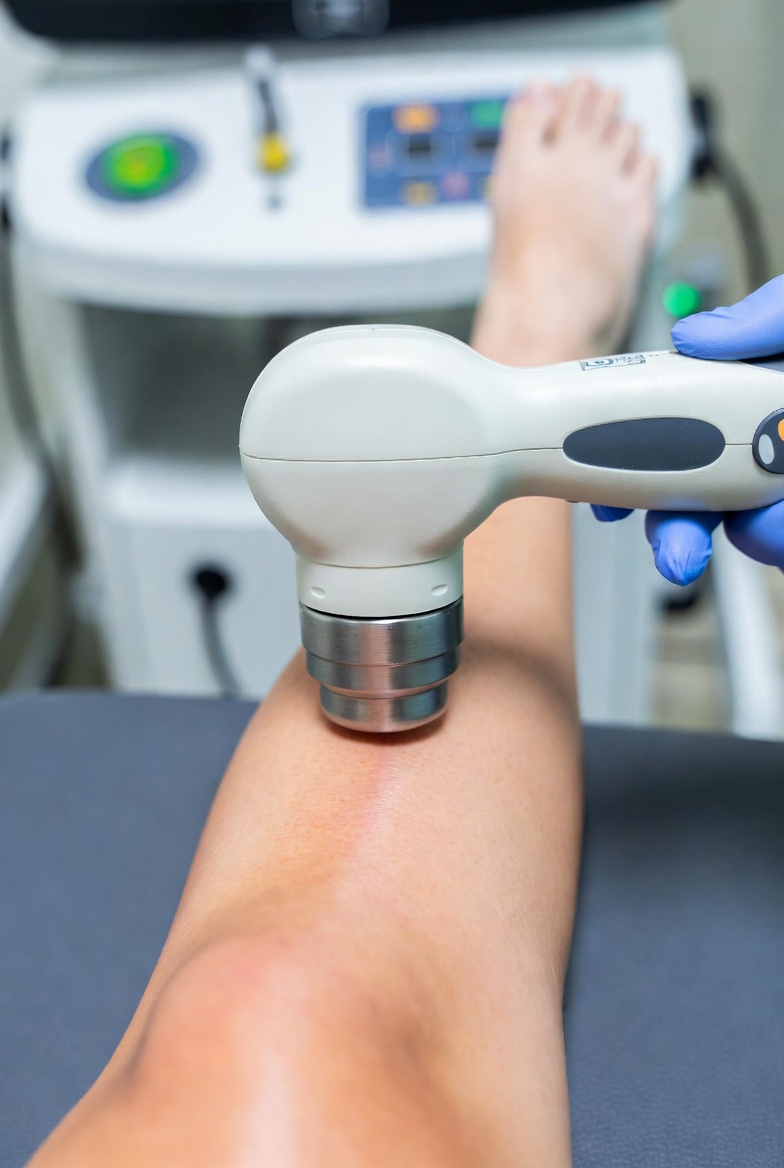
The shockwave device is applied directly over the target tendon with conductive gel. Pulses are delivered in a controlled sequence calibrated to the specific tissue depth and condition being treated. You will feel pressure — and in areas of significant degeneration, some discomfort during the session. This is expected. It reflects the treatment working at the tissue level and typically resolves quickly after each session ends.
Mild soreness at the treatment site for 24 to 48 hours following each session is common. Most patients manage this without difficulty and return to normal activity the same day.
Improvement in tendon pain and function is often not linear. Some patients notice meaningful change after two to three sessions. Others see the most significant shift in the two to four weeks following the completion of the full protocol, as collagen remodeling and tissue repair continue after active treatment ends.
How Shockwave Fits Alongside Other Approaches
Shockwave therapy is most effective for tendon conditions when it's part of a deliberate plan rather than a standalone treatment in isolation. At Harper MD, it frequently works alongside cellular regenerative therapy and peptide therapy — creating a more complete tissue repair environment, particularly for patients whose tendinopathy is compounded by broader recovery and hormonal changes.
For active adults whose tendon issues are part of a wider pattern — slower overall recovery, multiple joints affected, fatigue and hormonal changes that are affecting training — the evaluation at Harper MD looks at the whole picture. The tendon may be the presenting problem. The underlying environment that's making it harder to heal is often worth addressing at the same time.
If a chronic tendon condition has been limiting your sport, your training, or your daily function — and you've been through the standard treatment sequence without full resolution — it's worth having a direct conversation about what shockwave therapy can realistically offer for your situation. Book an evaluation at https://harpermd.mybodysite.com/harper-md-booking-page or learn more at harpermd.com/therapies/shockwave-therapy.
Frequently Asked Questions
How is shockwave therapy different from the ultrasound therapy I've had before? Ultrasound therapy uses low-energy sound waves primarily to warm tissue. Shockwave therapy uses high-energy acoustic pressure waves specifically calibrated to trigger a biological repair response at the cellular level. They operate through entirely different mechanisms and have different clinical applications. Shockwave therapy is not a stronger version of ultrasound — it's a different treatment category.
I've had tennis elbow for over a year. Is it too late for shockwave therapy to help? Not necessarily. Shockwave therapy has demonstrated meaningful clinical benefit even in long-standing tendinopathies. Longer duration does correlate with more entrenched tissue degeneration, which can affect the number of sessions needed and the timeline to full improvement — but duration alone doesn't disqualify a patient. An evaluation will give you a realistic picture of what to expect.
Can I continue playing sport during my shockwave protocol? In most cases, yes — with some modification. High-intensity loading of the treated tendon is typically reduced during the treatment course to allow the tissue repair process to proceed without being immediately overwhelmed. Your provider will give you specific guidance based on your sport, your tendon condition, and your training load.
Do I need imaging before starting shockwave therapy? Imaging can be helpful in confirming the diagnosis and the severity of tendon involvement — particularly ultrasound, which can visualize tendon degeneration and calcific deposits directly. It's not always required before beginning treatment, but it does inform the treatment plan. Your provider will determine whether imaging is indicated during your evaluation.
Harper MD | 17150 Royal Palm Blvd #3, Weston, FL 33326 | (954) 338-1111 | harpermd.com
This content is for educational purposes only and does not constitute medical advice. Individual results vary. Consult a qualified healthcare provider to determine whether shockwave therapy is appropriate for your specific situation.
