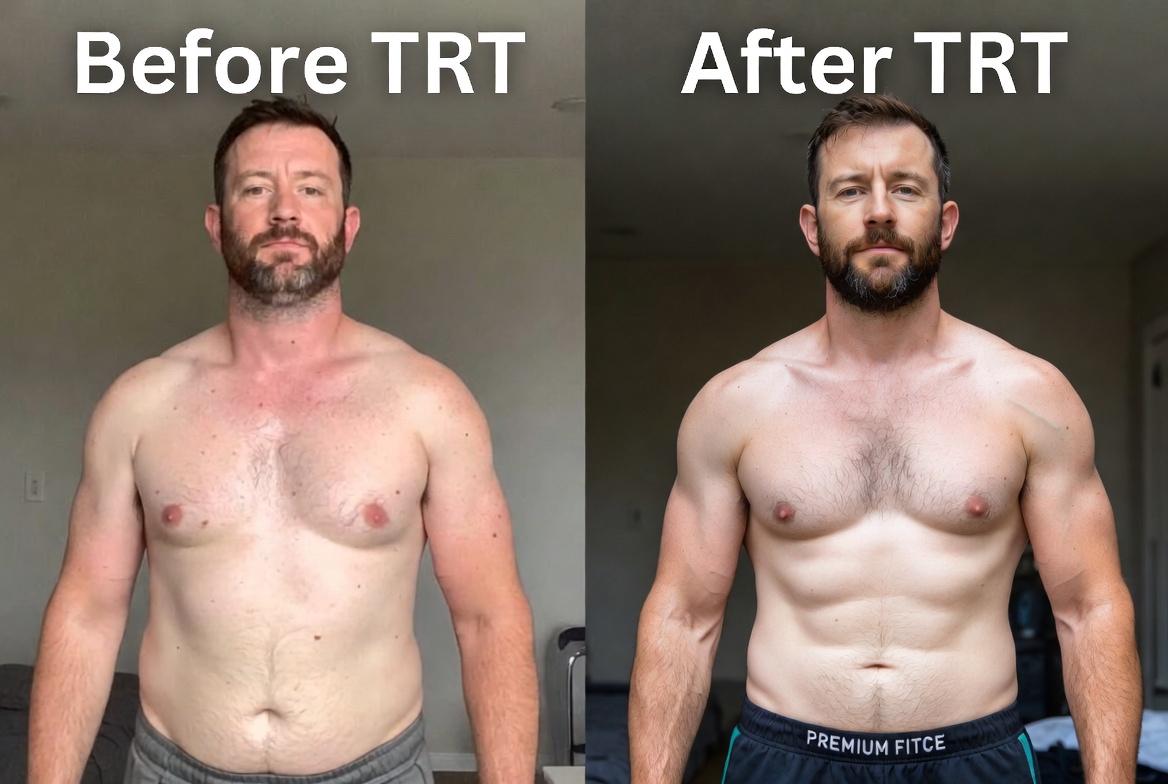
Low Testosterone and Body Composition After 45 — What's Changing and What You Can Do About It
You're training the same way you have for years. Your diet hasn't changed. You're not less disciplined. But the body is different.
The muscle that used to respond reliably to consistent training now takes more effort to maintain and less time to lose. The midsection that was never an issue now carries weight that doesn't shift regardless of what you do. The definition that came naturally in your 30s now requires considerably more work for considerably less result.
For a lot of active men in their late 40s and 50s, this is the moment they start wondering whether something has changed hormonally. Most of the time, something has.
Testosterone's effect on body composition is direct, well-documented, and clinically significant. Understanding what's happening — and what a medically supervised response looks like — is the starting point for addressing it effectively.
What Testosterone Actually Does for Body Composition
Testosterone is not just a hormone associated with sex drive and athletic performance. It is a primary regulator of body composition — one of the central signals that determines the ratio of muscle to fat that the body maintains at any given time.
Its role operates through several interconnected mechanisms:
Muscle protein synthesis. Testosterone directly stimulates the production of muscle protein — the process through which muscle fibers are built and maintained in response to training. When testosterone is at optimal levels, the anabolic signal from training is amplified. When it declines, the same training stimulus produces a weaker response. You work just as hard. The return diminishes.
Satellite cell activation. Satellite cells are the stem cells of muscle tissue — the repair and growth cells that respond to training demand by adding to existing muscle fibers. Testosterone activates satellite cells and extends their productive lifespan. As testosterone declines, satellite cell responsiveness decreases. Muscle repair and growth slow at the cellular level, independent of training effort or nutrition.
Fat metabolism and distribution. Testosterone influences how the body stores and mobilizes fat. It suppresses the activity of lipoprotein lipase — the enzyme that promotes fat storage — particularly in adipose tissue around the abdomen. As testosterone declines, this suppression weakens. Visceral fat — the metabolically active fat that accumulates around abdominal organs — increases. This is not a diet failure. It is a hormonal shift.
Insulin sensitivity. Testosterone supports insulin sensitivity — the body's ability to use glucose efficiently rather than storing it as fat. Declining testosterone is associated with reduced insulin sensitivity, which compounds the tendency toward fat accumulation and makes it harder for the body to use dietary carbohydrates effectively during and after training.
Growth hormone interaction. Testosterone and growth hormone work synergistically in supporting body composition. Both decline with age. When they decline together, the combined effect on muscle maintenance and fat distribution is greater than either would produce independently.

The Timeline — When This Starts and How It Compounds
Testosterone production in men peaks in the late 20s and declines at approximately one percent per year after that. By 45, many men have testosterone levels that are 15 to 20 percent lower than their peak. By 55, that gap can be 25 to 35 percent or more.
The decline is gradual enough that most men don't notice a single moment when things changed. What they notice instead is a slow accumulation of changes over several years — each one explainable on its own, but harder to dismiss when they're all present simultaneously.
The body composition changes are often the most visible and the most motivating to address. But they rarely exist in isolation. By the time a man in his late 40s or early 50s is noticing meaningful changes in his physique despite consistent training, the same hormonal shift is typically also affecting:
•Recovery capacity — workouts that used to clear in a day now take two or three
•Energy and drive — the motivational edge and competitive intensity that used to feel automatic
•Sleep quality — restorative sleep becomes less reliable, which compounds every other issue
•Mood and stress resilience — a flatness or emotional fragility that wasn't present before
•Sexual health and function — libido, performance, and satisfaction
•Cognitive sharpness — focus, memory, and processing speed
These are not separate problems. They are the downstream effects of the same hormonal environment. Addressing that environment addresses all of them — not just the one that brought the patient in.
Why Training Harder Isn't the Answer
The instinctive response for most active men when their body stops responding the way it used to is to train harder. More volume. More intensity. More discipline. This is understandable — and it's wrong, for a specific reason.
Training harder in a low-testosterone environment doesn't produce more anabolic stimulus. It produces more catabolic stress — the kind of physiological demand that breaks tissue down — without the hormonal infrastructure to rebuild it effectively. The result, over time, is not improved body composition. It's increased injury risk, deeper fatigue, and slower recovery.
This is one of the most common patterns in active men in their late 40s and 50s: they are training at high volume and intensity, their body composition is nonetheless shifting in the wrong direction, their recovery is poor, and they are increasingly sore and fatigued. The problem isn't effort. The problem is that effort alone can't compensate for a hormonal environment that isn't supporting the response they're trying to produce.
Nutrition optimization matters. Sleep matters. Training intelligence matters. But none of these fully compensates for a significant hormonal deficit — and recognizing that distinction is what allows the right intervention to be applied.

What a Medically Supervised Approach Actually Looks Like
The right starting point is not a prescription. It's an evaluation.
At Harper MD, an evaluation for low testosterone and body composition concerns begins with comprehensive lab work — total testosterone, free testosterone, SHBG, estradiol, LH, FSH, hematocrit, PSA, and a metabolic panel. These numbers in isolation don't tell the full story. They tell it in context — alongside the patient's symptoms, training history, health history, and goals.
Two men can have the same total testosterone number and have entirely different clinical pictures. Free testosterone — the fraction not bound to proteins and therefore biologically active — matters as much as total. SHBG levels affect how much testosterone is actually available to tissue. Estradiol levels affect how testosterone is being converted and what effects it's having downstream. An evaluation that looks at the full picture produces a protocol that is actually calibrated to the individual.
Protocol design. TRT protocols at Harper MD are built around the patient's clinical picture, lifestyle, and goals. Delivery options — injectable testosterone, topical preparations, subcutaneous pellets — have different pharmacokinetic profiles and suit different patients differently. The protocol is chosen based on what will work best for this individual, not what is most convenient to administer uniformly.
Body composition specifically. For men whose primary concern is body composition, the protocol often includes more than testosterone alone. Peptide therapy — particularly peptides that support growth hormone release — works synergistically with testosterone to improve the anabolic environment for muscle maintenance and fat metabolism. The combination addresses the full hormonal picture rather than a single variable.
Monitoring. Ongoing lab monitoring is built into the program. Testosterone levels, hematocrit, estradiol, and PSA are checked at defined intervals. The protocol is adjusted based on how the patient is responding — not set once and left alone. This is what distinguishes a medically supervised program from the $99-per-month franchise model.
What Realistic Expectations Look Like
Testosterone optimization is not a body recomposition shortcut. It restores the hormonal environment that makes training and recovery work the way they're supposed to — it doesn't replace the work itself.
For active men who are already training consistently and eating reasonably, restoring testosterone to an optimal range typically produces:
•Improved recovery between sessions — the ability to train with adequate frequency without accumulating unresolved fatigue
•Better muscle maintenance and, over time, improved response to resistance training
•Gradual reduction in visceral fat accumulation — particularly with the addition of peptide therapy targeting growth hormone
•More consistent energy and drive — the motivational substrate that makes sustained training effort sustainable
•Improved sleep quality — which compounds every other benefit
•Better mood stability and stress resilience
The timeline for meaningful body composition change varies. Most patients notice improvement in energy, recovery, and motivation within the first four to eight weeks. Visible body composition changes typically become apparent over three to six months of consistent training in an optimized hormonal environment.
The patients who do best are those who come in with realistic expectations, a consistent training foundation, and an understanding that the goal is optimization — restoring the body's ability to respond to the effort they're already putting in — not a substitute for that effort.
If the pattern described in this blog sounds familiar — and you want to understand what your actual hormonal picture looks like — an evaluation at Harper MD is the right starting point. Learn more at harpermd.com/services/anti-aging-longevity or book directly at https://harpermd.mybodysite.com/harper-md-booking-page
Frequently Asked Questions
My doctor tested my testosterone and said it was normal. Should I still get evaluated? Standard reference ranges for testosterone are broad and based on population averages — including men who are sedentary, overweight, and in poor health. A level that falls within the reference range is not necessarily optimal for an active adult whose symptoms suggest otherwise. Free testosterone, SHBG, and the full hormonal context matter as much as the total number. A more comprehensive evaluation often reveals a different picture.
Will TRT affect my natural testosterone production? Exogenous testosterone does suppress the body's natural production through a feedback mechanism. This is a known and manageable aspect of TRT — not a reason to avoid it, but a reason to pursue it through a clinic that monitors and manages it properly. For men concerned about fertility, this is an especially important conversation to have before starting any protocol.
How is Harper MD's approach different from the testosterone clinics that advertise online? The difference is evaluation depth and ongoing monitoring. Franchise testosterone clinics typically apply standard protocols based on minimal lab work and limited evaluation. Harper MD's approach starts with a comprehensive assessment of the full hormonal picture, builds a protocol specific to the individual, and monitors closely enough to adjust as needed. The goal is optimization — not a standard dose applied uniformly.
Can diet and exercise alone restore testosterone levels? Lifestyle factors — sleep quality, body fat percentage, resistance training, stress management — all influence testosterone levels and can support modest improvements in men with borderline low levels. For men with meaningfully suboptimal testosterone, lifestyle optimization alone is unlikely to produce the hormonal environment that resolves the clinical picture. It's an important foundation — not a sufficient replacement.
Harper MD | 17150 Royal Palm Blvd #3, Weston, FL 33326 | (954) 338-1111 | harpermd.com
This content is for educational purposes only and does not constitute medical advice. Individual results vary. Hormone therapy involves individual risk and benefit considerations that should be evaluated by a qualified healthcare provider.
