
Are Peptides Safe? Risks, Sourcing, and Why Medical Supervision Matters
Safety is the right thing to ask about before starting any therapy, and with peptides it is an especially important question, because the answer depends enormously on factors that have nothing to do with the peptides themselves. Where they come from, how they are dosed, whether you were properly screened, and whether anyone is monitoring your response all matter as much as the compounds.
This article gives an honest account of peptide safety, including what the research shows, what the real risks are, and why the single biggest safety variable is not the peptide but the context in which it is used.
This article is part of Harper MD's peptide therapy series. To understand how peptides compare to TRT, HRT, HGH, and other regenerative approaches, and how to choose the right one for your goals, read our comparison guide: Peptide Therapy vs. the Alternatives at harpermd.com/post/peptide-therapy-vs-alternatives.
What the Research Says About Peptide Safety
For the most studied peptides used in regenerative health, the safety profile in clinical research is generally reassuring, with important caveats about the limits of long-term data.
A review of the safety and efficacy of growth hormone secretagogues, the category including GH-releasing peptides, found that within the limits of current literature these compounds appear generally safe, with few of the cited studies observing serious adverse events. The same review noted honestly that more work is needed on long-term use, including cancer incidence and mortality. See: The Safety and Efficacy of Growth Hormone Secretagogues.
A 2026 review in Frontiers in Endocrinology examining GH-IGF-1 modulating peptides similarly synthesized the endocrine and metabolic effects relevant to clinical use, providing the kind of measured safety assessment that honest peptide care depends on. See: The Emerging Landscape of Performance-Enhancing Peptides, Frontiers in Endocrinology 2026. The reasonable summary is that for appropriate candidates, the well-studied peptides have a generally favorable safety profile in research, while long-term data continues to develop.
The Real Safety Issue: Sourcing
Here is the part of the peptide safety conversation that matters most and gets discussed least. The largest safety risk in peptide therapy is frequently not the peptide at all. It is where the peptide came from.
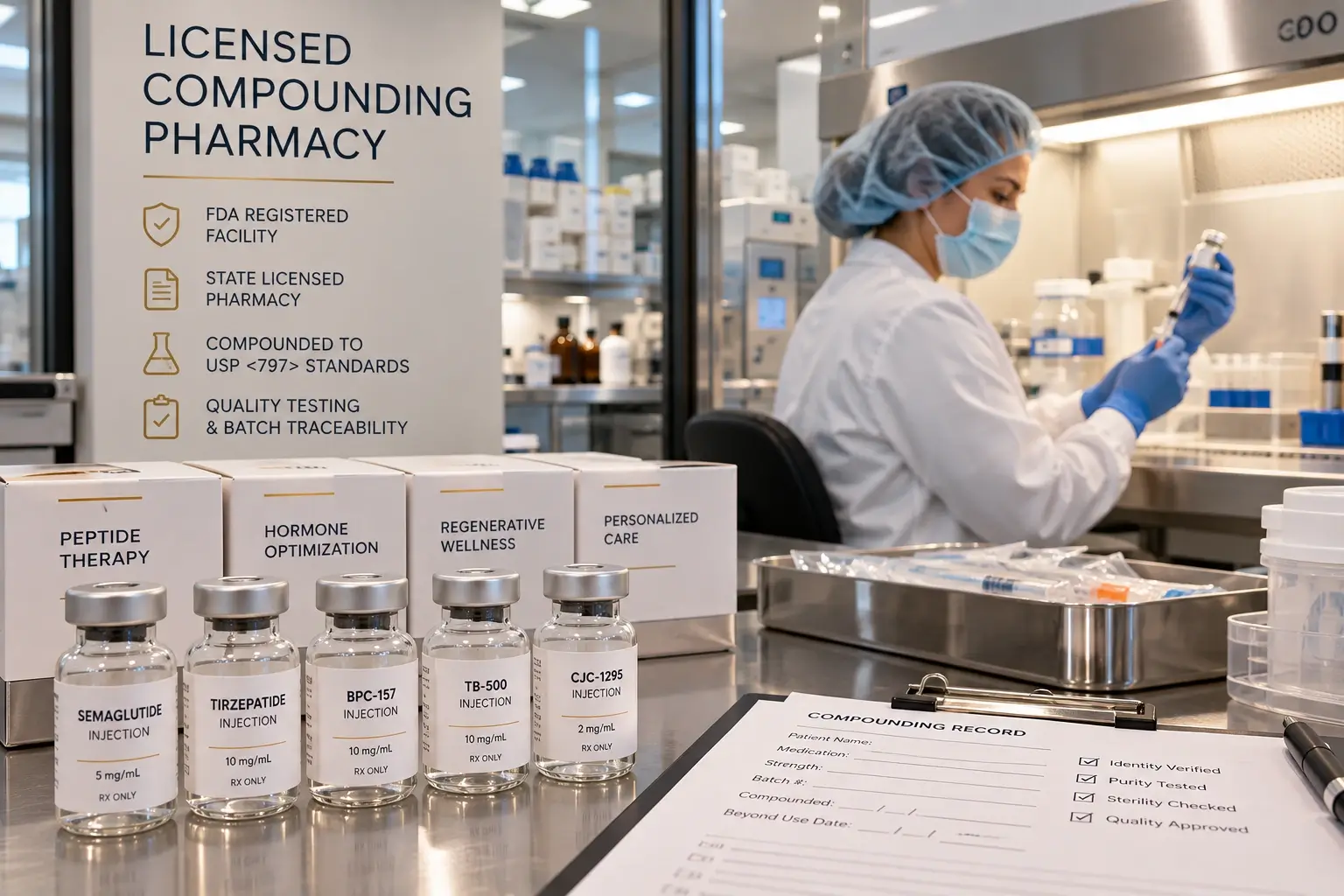
The peptide market has exploded, and alongside legitimate medical providers and licensed compounding pharmacies, there is a large gray market of online sellers, research chemical vendors, and direct-to-consumer sources. The differences in quality, purity, and accuracy of these sources are enormous. A peptide from an unregulated source may be contaminated, mislabeled, incorrectly dosed, or not actually the compound it claims to be.
When people are harmed by peptides, it is frequently traceable to an unregulated source rather than to the peptide itself used appropriately. This is the single most important safety principle in peptide therapy. The source determines much of the risk. A legitimate peptide from a licensed compounding pharmacy, prescribed and monitored by a medical provider, is a fundamentally different proposition than the same peptide ordered from an unverified website.
Harper MD sources peptides exclusively from licensed compounding pharmacies, which eliminates the contamination and purity risks that define the gray market. You can learn more about this approach on the peptide therapy page.
Why Screening and Monitoring Matter
Beyond sourcing, two other factors shape peptide safety significantly, and both require a medical provider.
Candidate screening. Certain health conditions, medications, and individual factors affect whether a given peptide is appropriate and safe for you. An evaluation that includes your health history and relevant lab work identifies these before you begin. Self-prescribing from an online source skips this entirely, which is where avoidable risk enters.
Ongoing monitoring. Medical supervision means your response is tracked over time through follow-up and, where relevant, lab work, so that the protocol can be adjusted and any concerns addressed early. This is a core difference between a supervised protocol and an unmonitored one.
These two factors, combined with legitimate sourcing, are what transform peptide therapy from the risky proposition it can be in the gray market into the carefully managed approach it should be.
Common Side Effects, Honestly
For appropriately selected and sourced peptides, side effects are generally mild, but you deserve to know what they can include. Depending on the specific peptide, these may include injection site reactions like redness or mild irritation, temporary water retention, changes in appetite, and, with some GH-releasing peptides, mild and transient effects as the body adjusts. These are generally manageable and are part of what your provider discusses with you and monitors.
More significantly, the honest position is that long-term data on some peptides is still developing. This is not a reason for alarm, but it is a reason for medical supervision rather than casual use, and it is something Harper MD discusses openly rather than glossing over.
If you want a straight, individualized conversation about whether peptide therapy is safe and appropriate for you specifically, that is what a free evaluation is for. Book at harpermd.mybodysite.com/harper-md-booking-page.
Frequently Asked Questions
Are peptides safe for healthy adults? For appropriate candidates using well-studied peptides from legitimate sources under medical supervision, the safety profile in research is generally favorable. The key qualifiers are appropriate candidacy, legitimate sourcing, and supervision, which is why evaluation matters.
What is the biggest risk with peptides? Frequently the sourcing. Peptides from unregulated online sellers or research chemical vendors may be contaminated, mislabeled, or incorrectly dosed. This is why Harper MD uses only licensed compounding pharmacies and why self-prescribing from online sources carries risk that supervised therapy does not.
Are there long-term studies on peptide safety? For some peptides, long-term data is still developing, which the research literature acknowledges honestly. This is a reason for medical supervision and monitoring rather than casual use, and it is something Harper MD discusses openly during your evaluation.
Can peptides interact with my medications? Potentially, which is exactly why candidate screening includes a review of your medications and health history. An evaluation identifies interactions and contraindications before you begin, something unsupervised use skips entirely.
Harper MD Health & Wellness | 17150 Royal Palm Blvd #3, Weston, FL 33326 | (954) 338-1111 | harpermd.com
This content is for educational purposes only and does not constitute medical advice. Individual results vary. Peptide therapy involves individual candidacy considerations that must be evaluated by a qualified healthcare provider. Not all peptides discussed are FDA-approved for all uses described. If you are experiencing a medical emergency, call 911.
